
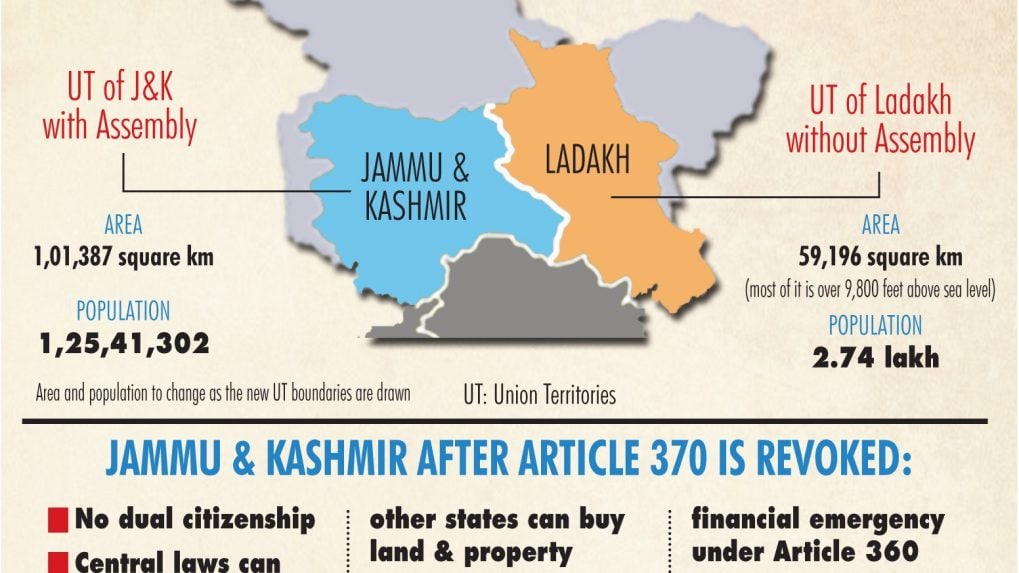

The recent pronouncement by the Supreme Court on Article 370 has sent shockwaves through the political terrain of Jammu and Kashmir, heralding a pivotal moment that promises far-reaching consequences. This judicial decree marks an epochal shift for the region, carrying profound implications for state parties and the impending reinstatement of statehood. At the same time, this also gives a big political and ideological boost to Bharatiya Janata Party (BJP) before the 2024 Lok Sabha elections.
Undoubtedly, the Supreme Court’s verdict on Article 370 constitutes a watershed moment in the annals of Jammu and Kashmir’s history, setting the stage for a recalibration of its political dynamics. The forthcoming restoration of statehood and the looming elections will play a defining role in shaping the region’s political contours. State parties are presented with a crucial opportunity to re-establish connections with the populace, addressing their concerns in a bid to regain political ground.
Concurrently, the BJP stands poised to capitalise on this verdict, reaping both political and ideological dividends to fortify its influence in the region. As Jammu and Kashmir navigates this transformative juncture, achieving a delicate equilibrium between regional aspirations and national integration becomes paramount for enduring peace and prosperity.
But at the same time, this verdict is a slap to the separatists and ecosystem that have ruined Kashmir for generations. The government has done its job, and the court has done the same. Now it is up to the mainstream political parties and the people of Kashmir to choose the path of development.
Effect on mainstream parties of Kashmir
In the wake of the seismic shift brought about by the abrogation of Article 370, the stalwarts of Kashmiri politics, the National Conference (NC) and the People’s Democratic Party (PDP), stand at a crossroads, grappling with a paradigm shift that has redefined their political narratives. Now that the Supreme Court of India has upheld the abrogation of Article 370 by the centre, it is imperative to look into the political change the valley is expected to witness.
The once unwavering reliance on Article 370 as the linchpin of their discourse has crumbled, thrusting them into a realm of political recalibration and reconnection with their electorate. While both parties vehemently decry the abrogation as an egregious affront to Kashmir’s identity and autonomy, their responses unveil nuanced distinctions in tone and strategy.
The National Conference, adopting a confrontational stance, openly criticised the BJP and channelled public sentiment through impassioned protests and demonstrations. In contrast, the People’s Democratic Party pursues a more delicate balancing act, cautiously preserving its political foothold while deftly navigating the concerns of its core constituency.
In the aftermath of the Supreme Court verdict, both parties declared their unwavering commitment to the restoration of Article 370. However, the stark reality dawns that the political landscape has irrevocably shifted. The upcoming election will demand more than the promise of Article 370 restoration, ushering in an era where the traditional modus operandi of these political behemoths undergoes a metamorphosis.
The abrogation of Article 370 holds profound implications for the political trajectory of Jammu and Kashmir, fundamentally reshaping its relationship with the Indian Union. The ripples of this decision extend beyond immediate responses, acting as a harbinger of a new political order in the region.
As the Supreme Court mandates the reinstatement of full statehood in Jammu and Kashmir, the onus lies on these mainstream political players to spearhead the region’s development. Ignoring or sidelining them in this transformative process would be a strategic folly for any government, not just the current BJP-led Central administration. In the post-September 2024 landscape, the political dynamics of Kashmir hinge on a delicate dance of collaboration, consultation, and consensus-building with these key stakeholders. The trajectory of Kashmir’s political evolution is intricately interwoven with the sagas of the NC and PDP, making their role indispensable in shaping the contours of a new Kashmir.
Effect on Hurriyat Conference and Separatist Ecosystem
The once-thunderous voice of the Hurriyat Conference, the valiant champion of Kashmiri self-determination, now fades into the distance, a mere echo reverberating in the cavernous halls of a bygone era. The historically vociferous movement has suffered a crippling blow as a result of the Article 370 repeal, leaving its legacy in jeopardy.
The Supreme Court’s resounding affirmation of the abrogation stands as an ideological triumph for the Bharatiya Janata Party (BJP), marking a significant blow to the separatist ecosystem. Regardless of one’s stance on the matter, the verdict resonates as a recalibration of the status quo, challenging the entrenched narratives that shaped the intelligentsia, academia, NGOs, and international peacekeeping organisations.
These entities, operating within the complex web of motives in Kashmir and leveraging the region’s unrest for various agendas, now confront a paradigm shift. There is a clear ideological defeat for the separatist ecosystem, which emphasises the necessity of reevaluating methods and tactics.
While the ongoing debate on whether a deeper exploration of the humanitarian crisis in Kashmir is warranted will persist, one undeniable reality emerges: the valley necessitates fundamental changes. The Supreme Court’s validation of the abrogation of Article 370 sets the stage for a transformative chapter in Kashmir’s history, bringing about a recalibration that, regardless of one’s stance, marks a turning point. The verdict heralds a departure from the entrenched narratives of the past, opening the door to a new era in Kashmir where the dynamics of power and influence undergo a profound shift.
A good opportunity for J & K parties
The recent pronouncement by the Supreme Court regarding the annulment of Article 370 serves as a poignant directive, casting a luminous mandate upon the central government to reinstate complete statehood in Jammu and Kashmir, a region previously designated as a union territory. Simultaneously, the Election Commission of India has been entrusted with the responsibility of orchestrating a transparent and impartial election in the state by September 30, 2024. This heralds the advent of a transformative epoch in the political panorama of Jammu and Kashmir, prompting major political entities such as the National Conference and PDP to redirect their attention towards localised concerns.
In light of the significant developmental advancements made under the auspices of central governance, as the Lieutenant Governor eloquently stated, the traditional electoral strategy of advocating for a developed Kashmir becomes outmoded. The restoration of statehood and the imminent electoral process proffer a gilded prospect for the denizens of Kashmir to reintegrate into a semblance of normalcy and partake in the democratic continuum.
To steer authentic progress, the people of Kashmir must ardently champion the cause of enhanced education, infrastructure, healthcare, electricity, and other imperative policies. The onus lies on the citizens of Jammu and Kashmir to exert influence upon mainstream political factions, compelling them to ardently espouse these pivotal issues for the collective well-being of the populace. This juncture, marked by the resurgence of statehood and the democratic exercise on the horizon, beckons for a concerted effort to recalibrate the trajectory of Kashmir’s developmental narrative.
Why an ideological boost to BJP
The scrapping of Article 370 has long been the BJP’s ideological Holy Grail. It’s the tangible embodiment of their commitment to the concept of “One Nation, One Constitution.” The Supreme Court’s endorsement of this move isn’t just a legal green light; it’s a resounding ideological fist pump. This verdict is the judiciary giving a nod to the BJP’s backbone, sending a clear, unapologetic message to both their loyalists and the entire nation. The Court has essentially stamped the BJP and its leadership as unyielding architects of decisions, reinforcing an image of unapologetic decisiveness.
The audacious revocation of Article 370, now legitimised by the apex court, showcases a government that doesn’t just talk tough but walks the talk. This isn’t just governance; it’s governance with a spine. The move not only symbolises strong-willed leadership but also lays down a marker: the BJP is unafraid to take the heat if it means serving the nation’s interests. This isn’t political posturing; it’s a bold statement of governance.
And let’s not mince words about timing—the Supreme Court’s pronouncement is like political rocket fuel for the BJP right before the 2024 general elections. The party can ride the waves of this historic decision, turning regional success in Jammu and Kashmir into a national power play. The apex court’s endorsement of the nationalistic and pro-development message undoubtedly influenced the voters, who might just give the BJP a decisive victory.
In essence, the Supreme Court’s ruling on Article 370 isn’t just a legal verdict; it’s a political adrenaline shot. It isn’t just about the BJP’s ideology; it’s about PM Narendra Modi being etched in the public psyche as a leader who doesn’t flinch in the face of tough decisions. This endorsement by the apex court not only cements the party’s current standing but also sets the stage for what could be a triumph of epic proportions in the upcoming 2024 general elections.
Way Forward
In summation, the pronouncement by the Supreme Court on Article 370 transcends the realms of a mere legal decree; it represents a tectonic shift in the intricate political and ideological contours of Jammu and Kashmir. The restoration of statehood, coupled with the imminent electoral horizon, holds the promise of reshaping the narrative of the region, providing fertile ground for political entities to transcend the tumultuous echoes of the past.
This juncture presents an invaluable opportunity for political actors to ascend beyond historical discord and articulate a vision harmonising with the deep-seated aspirations of the populace. The abrogation of Article 370 has propelled key Kashmiri political entities, the National Conference (NC) and the People’s Democratic Party (PDP), into a realm of recalibration. While the NC adopts a confrontational stance, the PDP delicately balances preservation and navigation.
The Supreme Court’s mandate for full statehood restoration places on these players the onus of spearheading Kashmir’s development. Ignoring them in this transformative process would be a strategic folly. Simultaneously, the once-thunderous voice of the Hurriyat Conference fades post-Article 370, marking an ideological triumph for the BJP. Regardless of one’s stance, the verdict necessitates a recalibration, emphasising the urgency for fundamental changes in Kashmir. The valley is poised for a transformative chapter, departing from entrenched narratives to a new era of shifted dynamics.
For the Bharatiya Janata Party (BJP), this juncture is not merely a political triumph but an ideological zenith, affirming their steadfast commitment to the vision of “One Nation, One Constitution.” Conversely, for regional parties, it serves as a clarion call to metamorphose and rejuvenate, urging them to forge renewed connections with the grassroots. Most importantly, for the people of Jammu and Kashmir, this moment signifies more than an electoral process; it is an invitation to reclaim agency, an active role in shaping the destiny of their homeland.
Unfolding a new era
The resounding thud of the gavel echoes beyond the courtroom, settling like dust after a seismic event. Jammu and Kashmir now teeters at the edge of a transformative epoch, one that necessitates not merely political sagacity but a collective dedication to authentic progress and the tenets of democracy. As the curtain falls on one chapter, the unfolding pages of this new era beckon a concerted effort to navigate the path forward with wisdom, resilience, and an unwavering commitment to the democratic ethos.
—The author, Prof. Sayantan Ghosh, is a political observer and research scholar. He teaches journalism at St. Xavier’s College, Kolkata. The views expressed are personal.
(Edited by : C H Unnikrishnan)