
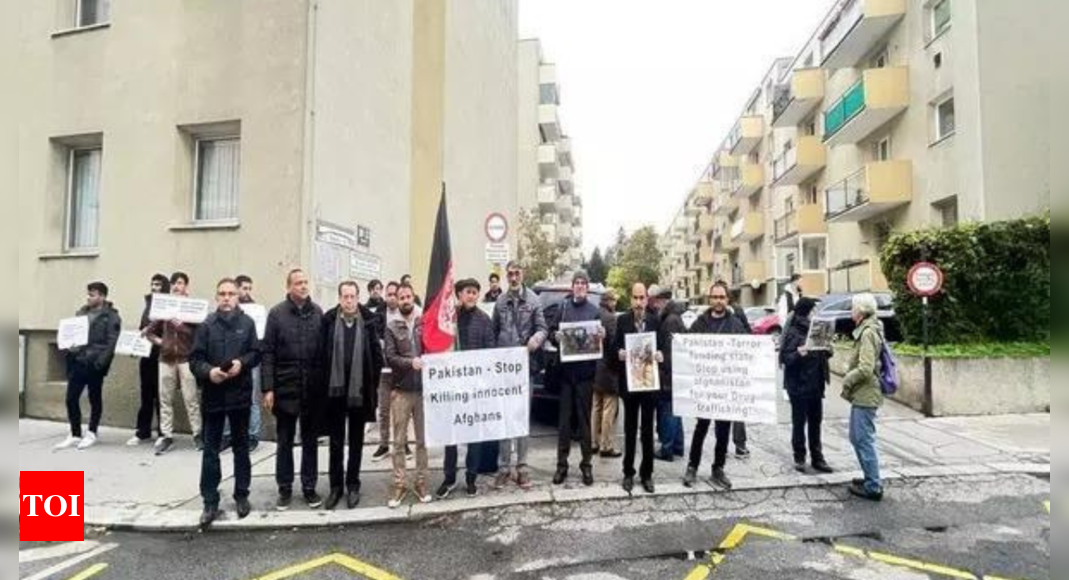

VIENNA: The Afghan community in Austria held a demonstration outside the Pakistan Embassy in Vienna protesting against the ongoing mistreatment of Afghan refugees by the Pakistan government, as per the Afghan Diaspora Network.
Following Pakistan’s announcement of a deadline for undocumented Afghans to leave the country, approximately 200,000 Afghans have returned home via the Torkham border, reported The News International.
The increase in repatriations comes after the Pakistan government ordered 1.7 million Afghans living illegally in the country to leave or face deportation, as reported by Dawn.
The protest was organized by the Afghan Cultural Association, AKIS, and received support from various Afghan Diaspora organizations.
Around 80 members of the Afghan diaspora community participated in the protest, voicing opposition to the deportation of Afghan refugees by Pakistan, reported the Afghan Diaspora Network.
They also displayed banners denouncing Pakistan’s actions and highlighted Pakistan’s role in meddling in the internal affairs of Afghanistan.
Several prominent Afghans from Austria, including Abdul Malyar, Fazel Rahman, and Stoorai Khan, spoke at the protest, strongly criticizing Pakistan’s actions.
They urged the international community to pressure Pakistan to stop the forced return of Afghans who have been residing in Pakistan for many years, as per the Afghan Diaspora Network.
Furthermore, they emphasized that the Pakistan Army is responsible for the terrorist attacks in their country as they nurtured these terror organizations in their early years and supported them with arms and ammunition.
They asserted that Pakistan is paying the price for its own actions and cannot shift the blame to Afghans who migrated to Pakistan long ago.
Malyar, who has lived in Austria for over 40 years, stated that Pakistan’s forceful deportation is a mechanism to interfere in the internal affairs of Afghanistan and to divert attention from core issues in Pakistan during the upcoming elections.
Moreover, with the ongoing economic crisis in Pakistan, it also plans to use this issue to attract more international aid in the name of refugees, as cited by the Afghan Diaspora Network officials.
Following Pakistan’s announcement of a deadline for undocumented Afghans to leave the country, approximately 200,000 Afghans have returned home via the Torkham border, reported The News International.
The increase in repatriations comes after the Pakistan government ordered 1.7 million Afghans living illegally in the country to leave or face deportation, as reported by Dawn.
The protest was organized by the Afghan Cultural Association, AKIS, and received support from various Afghan Diaspora organizations.
Around 80 members of the Afghan diaspora community participated in the protest, voicing opposition to the deportation of Afghan refugees by Pakistan, reported the Afghan Diaspora Network.
They also displayed banners denouncing Pakistan’s actions and highlighted Pakistan’s role in meddling in the internal affairs of Afghanistan.
Several prominent Afghans from Austria, including Abdul Malyar, Fazel Rahman, and Stoorai Khan, spoke at the protest, strongly criticizing Pakistan’s actions.
They urged the international community to pressure Pakistan to stop the forced return of Afghans who have been residing in Pakistan for many years, as per the Afghan Diaspora Network.
Furthermore, they emphasized that the Pakistan Army is responsible for the terrorist attacks in their country as they nurtured these terror organizations in their early years and supported them with arms and ammunition.
They asserted that Pakistan is paying the price for its own actions and cannot shift the blame to Afghans who migrated to Pakistan long ago.
Malyar, who has lived in Austria for over 40 years, stated that Pakistan’s forceful deportation is a mechanism to interfere in the internal affairs of Afghanistan and to divert attention from core issues in Pakistan during the upcoming elections.
Moreover, with the ongoing economic crisis in Pakistan, it also plans to use this issue to attract more international aid in the name of refugees, as cited by the Afghan Diaspora Network officials.