

Quite a few people have a quirky way of looking at things. Some treat wars like they are cricket matches, not considering the aftermath or the suffering it causes, and view cricket as if it were a war, forgetting that it’s just a game. When news of tensions between countries comes up, there are always a few who suggest war as the solution, while comfortably sharing their opinions from the safety of their homes, far from border areas. In fact, even our movies, in a way, celebrate wars so much that they seldom shed much light on what happens to civilians during and after these intense battles.
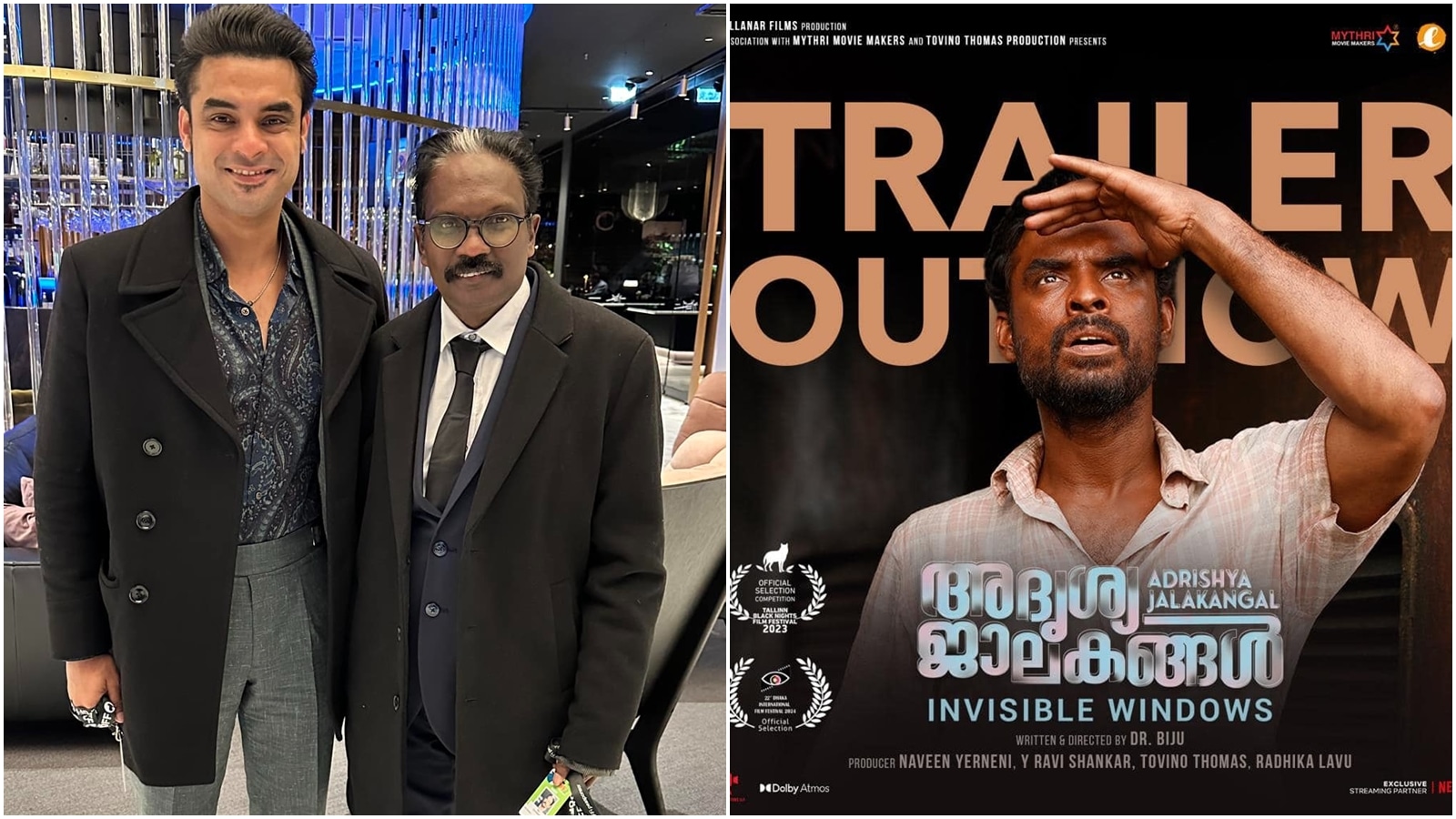
National Award-winning director Dr Bijukumar Damodaran Tovino Thomas-starrerr Adrishya Jalakangal (Invisible Windows) is at its core an anti-war film with elements of magical realism. “Adrishya Jalakangal stands out from the movies we are accustomed to. It embraces magical realism, a style not commonly seen in Malayalam cinema. The specific location where the story unfolds is irrelevant; the narrative and characters are crafted in a way that makes the events plausible anywhere in the world. While one may have encountered people resembling the characters in this movie, Adrishya Jalakangal’s story resonates with the social situation in any country. The inclusion of surrealistic and magical realistic elements enriches the overall narrative,” Dr Biju tells The Indian Express.
Discussing the film’s theme in depth, Dr Biju notes, “Keralites or South Indians, in general, haven’t directly experienced wars. Even massive communal riots have been relatively uncommon here, except for a few regional incidents. Consequently, we’re unfamiliar with the aftermath of wars. Yet, whenever a war erupts anywhere in the world, it profoundly impacts that society. Unfortunately, when we observe such conflicts from this side, they might appear as merely a source of entertainment. However, that’s not the reality. It’s the common people who bear the brunt during times of wars, impending wars or communal riots. Women, children and marginalised people are the most adversely affected. Adrishya Jalakangal is crafted from this angle, aiming to depict how wars impact ordinary people without any privileges.”
Watch Adrishya Jalakangal trailer here:
A three-time winner of the National Film Awards and recipient of numerous prestigious international accolades, it is the title of his films that are the initial draw for audiences. Among his most acclaimed works are Veettilekkulla Vazhi (The Way Home), Perariyathavar (Names Unknown), Valiya Chirakulla Pakshikal (Birds With Large Wings), Kaadu Pookkunna Neram (When The Woods Bloom), Sound of Silence, Veyilmarangal (Trees Under the Sun) and now Adrishya Jalakangal (Invisible Windows), which had its world premiere at the 27th Tallinn Black Nights International Film Festival (TBNIFF) in Estonia.
When asked how he comes up with such names for his projects, Dr Biju explains, “Titles usually take shape during the writing phase. For Perariyathavar, I settled on the title after finishing the script and considering various other options. In contrast, Akasathinte Niram (Colour of Sky) and Veettilekkulla Vazhi had their titles right from the start. A name comes to us as we’re brainstorming a story, while writing or even after completing the writing process. The title is crucial to paint a vivid picture of the movie and pave the way for the film. Take Adrishya Jalakangal, for example. Windows are visible elements, and in reality, there are no invisible windows. An invisible window suggests either magical realism or a surrealistic concept. Such a title helps us easily immerse ourselves in the movie’s world. Personally, I believe titles should suit the film and carry a poetic touch.”
Adrishya Jalakangal initially attracted attention for its first look posters showcasing Tovino Thomas, who underwent a remarkable transformation for the lead role. However, the discussions about Tovino’s look became so intense that it created an impression that such appearances were not normal. Consequently, we considered it only fair to ask Dr Biju whether these discussions about appearance are problematic in themselves. Agreeing with that, Biju says, “In the movie, his appearance reflects that of many people we encounter in our society. This gained a lot of attention because it was the first instance of Tovino undergoing such a significant physical transformation. However, in the movie, his character is portrayed as an everyday working-class person.”
On blackfishing Similarly, in recent years, many movies have faced criticism for casting fair-skinned actors and having them transform to depict characters with darker skin tones. As Tovino’s situation here shares some similarities, we discussed this aspect with Biju. “While criticism could potentially be directed towards Adrishya Jalakangal, the situation is different here. Blackfishing is actually different. For instance, in a biopic or a film featuring a well-known character with a confirmed black identity, selecting a fair-skinned actor for such a role may indeed be akin to blackfishing. It is inappropriate to choose a white or fair-skinned actor, alter their appearance to look black, and cast them as Nelson Mandela or Ayyankali. Blackfishing occurs when actors with contrasting skin tones are cast to portray real historical figures or literary characters with clearly defined black identities,” he observes.
“However, Tovino’s character in Adrishya Jalakangal is entirely fresh. It is not based on any real-life persons or literary characters. When introducing such new and fictional characters, using any actor by altering their appearance is acceptable. Also, given the substantial budget required for a movie of this scale, especially in Malayalam cinema, casting an actor with significant market value becomes necessary. Unfortunately, a black-skinned actor with such market value is currently unavailable in Malayalam, leading to the selection of actors from the existing pool,” the director adds.
On his central characters and the ‘pan-Indian’ phenomenon A filmmaker boasting an impressive repertoire, a notable characteristic of many of his central characters is their pursuit of discovering their true purpose. Commenting on the same, Dr Biju says: “Most of my central characters, with very few exceptions, belong to marginalised communities. Even when the central characters are not from these communities, the story/premise unfolds within marginalised settings. Consequently, many characters in my movies do not have names. This choice is not made for poetic reasons but instead to highlight that they don’t even have identities due to their origins in these marginalised strata without any privileges. Their identity crisis is a significant issue, reflecting challenges in the real world as well. Therefore, my consistent endeavour is to portray on screen the lives of people grappling with identity crises.”
Malayalam cinema, much like its regional counterparts, consistently delved into and portrayed the lives of ordinary people, deeply rooted in their surroundings. However, there’s a valid concern that in the pursuit of creating formulaic ‘pan-Indian’ films, we might be sacrificing our unique voices. Biju, nevertheless, asserts that the films we label as ‘pan-Indian’ do not authentically represent the cross-culture of India. “Movies labelled as ‘pan-Indian’ today are primarily those that enjoy widespread releases and significant box office success across the country. However, this label isn’t attributed to them based on cultural themes or aesthetics. Films like Baahubali and KGF, although commercially successful, resemble old classics like Sholay and don’t necessarily represent India’s cross-culture. True ‘pan-Indian’ films are those that tell stories relevant to all places and people in the country. Examples include Satyajit Ray’s films, particularly Pather Panchali (1955), which remains relevant even today due to its exploration of social realities and its timeless narrative. Unfortunately, these genuinely pan-Indian films often have limited releases.”
On Malayalam cinema When asked about the current standard and quality of Malayalam films, Dr Biju says: “In my opinion, we are approaching current Malayalam cinema from only one perspective – how much a film entertains people in theatres. Entertainment takes various forms. While massive, unrealistic films like Baahubali and KGF captivate us with their scale, movies like Jailer entice audiences with depictions of massive violence. The third category comprises smaller films, typical of what we produce in the Malayalam industry, exploring family-oriented themes and showcasing humorous moments.”