
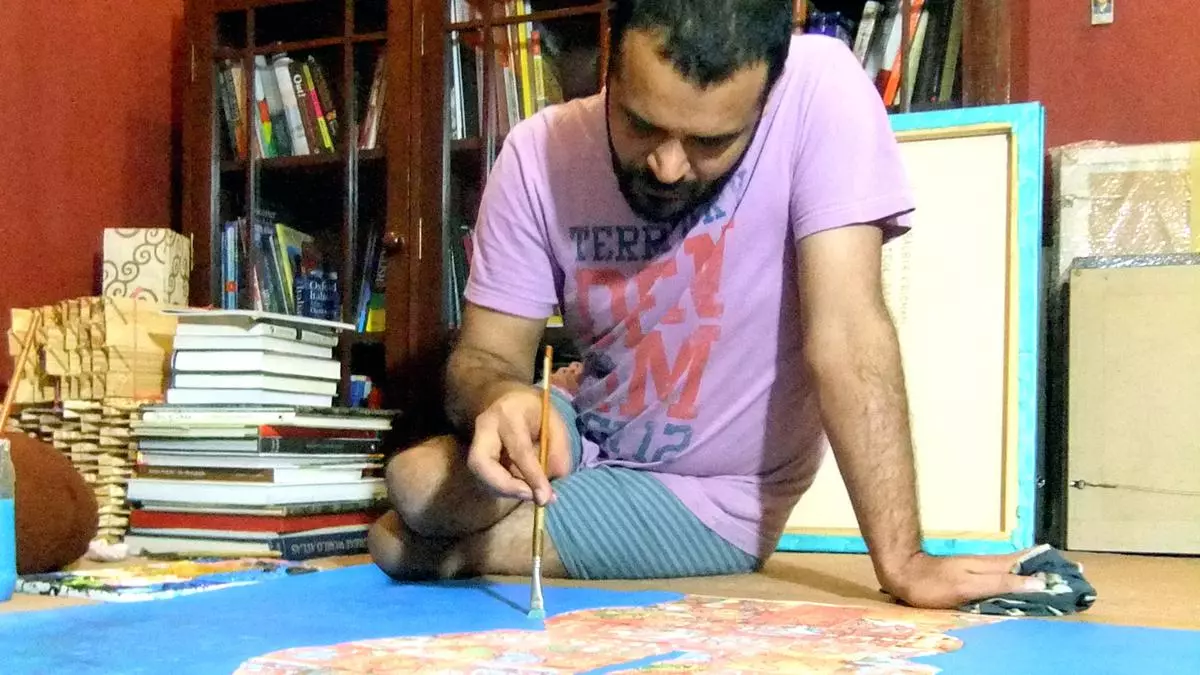

Ten years ago, artist Balbir Krishan organized a solo show called “Out Here and Now,” which focused on queer themes, in New Delhi. During the exhibition, Krishan, who wears prosthetic legs, was attacked by a masked intruder who damaged one of his paintings. This incident not only shook Krishan but also brought attention to a type of art that was often hidden.
This year, Emami’s Kolkata Centre for Creativity is hosting an exhibition centered around the theme of “being Queer, being Home” to celebrate Pride month. The exhibition includes works such as pictures of rainbow curtains, paintings using gouache and body hair, and a framed watercolor of a forest hanging from a real tree branch. Artist Indrani Banerjee explains that the bifurcated branch symbolizes bisexuality, the picture represents the forest where she longs to belong, and the bare branch signifies isolation.
Parmesh Shahani, the author of “Queeristan: LGBTQ Inclusion in the Indian Workplace,” is well-versed in various queer projects across the country, including the Queer Awadh Literature festival, the regional organization Ya All in Manipur, and online platforms like the Queer Muslim Project. Shahani also points out that sports stars like Dutee Chand and transgender Bharatanatyam dancer Narthaki Nataraj have become LGBTQIA+ icons.
The lifting of Section 377 of the Indian Penal Code, which criminalized homosexuality, may seem responsible for the recent surge of queer art and culture, but it is just a small part of India’s extensive history of queer art. Avijit Ghosh, an artist based in Paris, explores queer themes through mythology, featuring figures like Siva, Ardhanarishwara, and David and Jonathan from Christian lore. Ghosh believes that queer love is neither new nor exotic, as evident in Greek mythologies. Ghosh’s painting “Dance of Tandava” depicts Siva cradling Jesus, representing a story of love between two icons from the East and West.
Queer love stories have often been portrayed as tragic or caricatures in popular culture. However, recent OTT series and films like “Made in Heaven,” “Shubh Mangal Zyada Saavdhan,” and “Badhai Do” have brought queer love stories out of the closet. Sridhar Rangayan, director of the Kashish Mumbai International Queer Film Festival, explains that these series and films present LGBTQ characters as part of a family rather than as parodies or passing references. This increase in content allows the festival to explore more diverse and edgy topics, such as a film showcasing a gay upper-caste and Dalit relationship or same-sex desire amidst communal riots in Gujarat.
While Pride Month is relatively new in India, LGBTQIA+ artists like Hoshang Merchant and R. Raj Rao have been creating their space for years. Shobhna S. Kumar, the founder of Queer Ink, started an online bookstore in 2010 to provide LGBTQIA+ literature that was scarce at the time. Now, mainstream publishing houses have “Pride lists” and are releasing LGBTQIA+ books on various topics. LGBTQIA+ artistes are also gaining visibility beyond their queerness, as their work encompasses various aspects of their lives. For example, Anumitra Ghosh Dastidar and Shalini Krishan of Edible Archives, a restaurant and culinary heritage project, can discuss indigenous rice and their relationship as a couple with equal passion.
This increased visibility has allowed queer artistes to express themselves in various ways, including traditional poetry, slam, open mic sessions, comedy, and music. The community’s forms of self-expression have become more diverse and direct, with fewer filters. However, there is a risk of commoditization of the LGBTQIA+ community in this cultural discovery. Influencers like Arnab Biswas utilize their platform to promote their work and secure paid opportunities. Pink capitalism and pink washing during Pride Month are criticized, but some individuals, like Biswas, see it as an opportunity to empower themselves and demand fair compensation for their work.
Parmesh Shahani suggests that instead of being concerned about pink capitalism, individuals should seize this moment and ensure that the attention leads to job opportunities, particularly within the government, which is the largest employer. Genuine change will occur when trans actors are not rejected for not conforming to certain stereotypes, but rather embraced for their talent.