
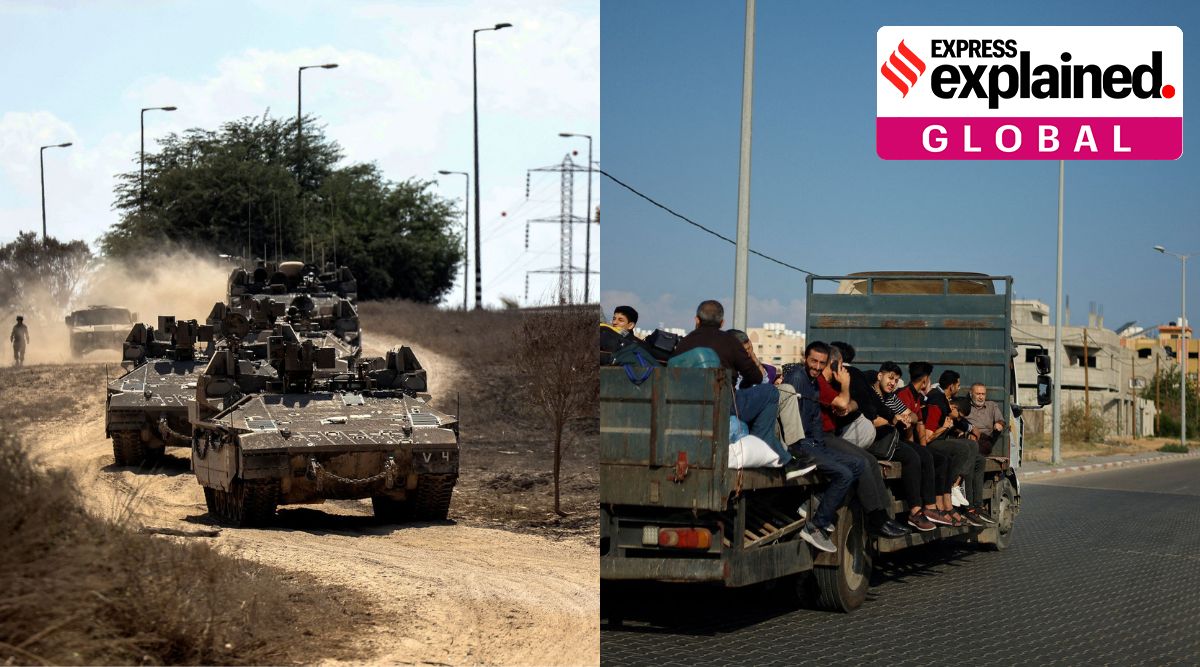

Late on Saturday (October 14), Israel issued a new warning to Palestinians in northern Gaza and offered a three-hour window where a main highway to the south would not be targeted. The possibility of a ground invasion to “destroy and crush” Hamas seems imminent. Khaled Al Hroub, a scholar of the Middle East, discussed the consequences of the Israeli campaign and its implications for the Palestinian movement and the residents of Gaza.
An Israeli ground invasion of Gaza would lead to a severe humanitarian catastrophe due to its high population density. Innocent civilians would suffer the most, as Hamas military members are difficult to find. There is no clear Israeli roadmap for the outcome of an invasion, which would result in more loss of life and resistance from smaller groups. Additionally, Israel has cut off essential supplies and urged people to leave.
The Israelis are pushing for the expulsion of Palestinians from Gaza to Egypt and the Sinai desert, particularly in the northern part of the Strip. However, Egypt rejects this plan and refuses to allow mass immigration. Transferring a million people to the southern part of Gaza would create further problems.
The West, including the US and Europe, unconditionally supports Israel’s brutal operation, despite Western human rights groups labeling it as war crimes. The 2 million Palestinians in Gaza are trapped between a slow and quick death.
Hamas is not just an armed group, but also a social, religious, political, and military organization deeply integrated into Palestinian society. Its history dates back to the Palestinian Muslim Brotherhood and it gained support among Palestinians after peace talks failed in 2000. There are theories that Israeli Prime Minister Benjamin Netanyahu has helped strengthen Hamas to maintain a political rift between factions and prevent negotiations.
It would be difficult for Israel to completely eliminate Hamas as it is deeply entrenched within Palestinian society. If Hamas were removed from power, more extreme splinter groups could emerge. The role of Fatah, led by Mahmoud Abbas, in the crisis is uncertain due to internal divisions and Israeli control in the West Bank.
The October 7 attacks on Gaza have discredited the 2020 Abraham Accords between Israel and Arab nations. Saudi Arabia has frozen talks of normalization with Israel due to the situation. These events have derailed or delayed the potential US-led deal between Israel and Saudi Arabia.
Khaled Al Hroub is a professor at Northwestern University in Qatar with expertise in Middle Eastern studies, politics, and the Arab-Israeli conflict.