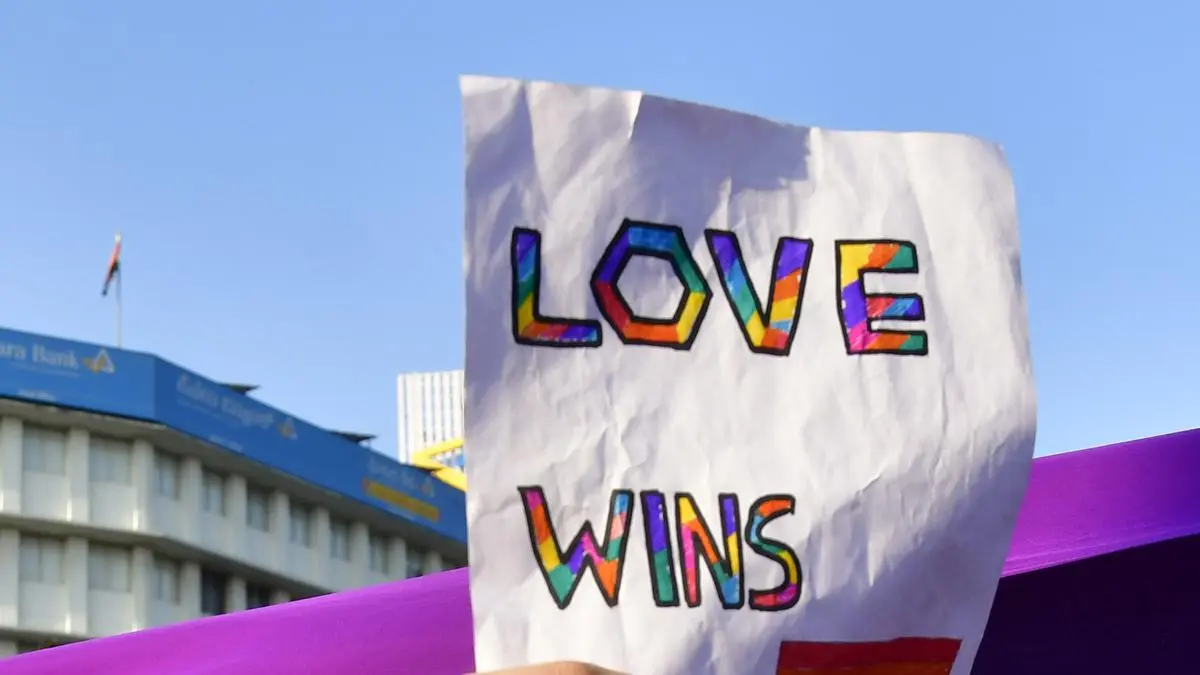

It drizzled throughout the day, bringing down June temperatures and promising a pleasant night for the first time in an extremely hot month in New Delhi. People arrived in ones and twos, in cycle rickshaws and taxis and climbed the stairs to a third floor apartment in old Delhi. Lights were dim in the living room and the atmosphere congenial. Gradually the dance floor filled up with cismen in long skirts and flowing hair, women with tattooed chests, transitioning bodies with stubbled chins and all the in-betweens in flowing dresses and sarees. A violin quivered from somewhere in the shadows, accompanied by the earthy beats of a djembe. The shimmies of a hip belt added to the magic of an evening which was quickly turning humid. But no one cared. It was a night of freedom and forgetting for the non-normative crowd gathered there. Some were queer and identified with a category on the LGBTQIA+ (lesbian, gay, bisexual, transgender, queer, intersex, asexual, etc) spectrum, others were allies. Some just wanted to get away from the binding demands of a long day and disappear into the crowd where one was free to imagine alternate realities. Queer Nightlife (2021) by Kemi Adeyemi, Kareem Khubchandani, and Ramon H. Rivera-Servera. In the introduction to their book Queer Nightlife (2021), Kemi Adeyemi, Kareem Khubchandani, and Ramon H. Rivera-Servera write that the night offers an alternative set of rules for the LGBTQIA+ community, whose desires, pleasures, bodies, and existences are invalidated in the propriety of daytime.They caution: “But for all of the ways that queer nightlife spaces can provide refuge and play, they can also be sites of alienation that are circumscribed by normative modes of exclusion. Our account of entry protocols in Puerto Rico illustrates how the night, seemingly loose and free for purposes of leisure that complement the laborious day, is in fact deeply regulated by curfews, last calls, the closure of public transportation, the vigilance of door staff and the police alike, school hours, and the work bell. Who then comes out at night, capitalises on its flexibility and ambiguity, and risks the surveillance that penetrates darkness? What does it mean to live your life, or more specifically, to ‘get your life’ at night?” The book is a compendium of essays on the nightlife of queer folx. The writers centre the labour of queer people who apprehend the risky medium of the night to explore, know, and stage their bodies, genders, and sexualities in the face of systemic and social negation.In a country like India, spaces like the one described above at once become special and exclusive, given the way human bodies and desires continue to be regulated through a feudal and patriarchal lens, regardless of the decriminalisation of same-sex relationships in 2018 by the Supreme Court.Temporary, permanent or mobile spaces like the living room or a gay bar or a public park allow for varied expressions of love and passion, but also for the absence of sexuality (the A in LGBTQIA+ stands for asexual). These spaces enable a collision and/or dialogue between diverse identities of caste, class, religion, and nationality. They blur boundaries and create new complex identities. More than anything, they are spaces that allow for the reimagination of a heteronormative society, putting the actors in a direct confrontation with patriarchy. The annual queer pride march in New Delhi in 2019. | Photo Credit: SUSHIL KUMAR VERMA LGBTQIA+ is a useful tool as it reflects the various identities on the rainbow, but the + is a reminder that no acronym can capture the distinct individuals whose bodies and lives defy categorisation and who, in reality, inhabit multiple universes simultaneously.“What’s your pronoun?” has become a common question in progressive English spaces. A professor teaching feminist studies began her lecture in the classroom on the first day of her course with this question. She, as the teacher liked to be called, went around the room asking each student how they would like to be addressed for the rest of the year, whether as a he, she or they. Whether a classroom exercise like this would have been possible before the decriminalisation of homosexuality in India is a moot question. Pride MonthJune is celebrated as Pride (professionalism, respect, integrity, diversity, excellence) Month across the world to spark conversations about gender and sexual minorities and make their concerns a part of public discourse. June was chosen to commemorate the Stonewall riots of 1969 in New York, a rebellion that marked an important turning point in the freedom movement of the queer community. In India, the first public Pride march was held in 1999 in Kolkata with barely 15 participants. The march itself was called “Friendship Walk”. From 1999 to 2022, Pride parades were held in 20 cities and more across the country. But do more and more Pride marches signify that all is well with the queer community in India? The usurpation of Pride Month by rainbow capitalism might misrepresent to the larger public that finally the community has been liberated but it is a false perception. As trans and Dalit rights activist Grace Banu sums it up, “Yes, we are celebrating Pride month, but what does it even mean for someone in rural India who doesn’t know what Pride is and has no safe space or privilege to practise it?” Four years after the Supreme Court read down Section 377 of the Indian Penal Code, decriminalising same-sex relationships, has the physical, mental, emotional, and economic violence against the queer community been addressed or does it continue unabated? What happens when they exercise their full rights as equal citizens of the country and participate in pressing political matters of the day? The Mumbai Queer Azadi March in February 2020. | Photo Credit: REUTERS/Francis Mascarenhas In early 2020, when the country erupted against the divisive Citizenship (Amendment) Act and the National Register for Citizens, the queer folx in many places decided to be a part of the movement. In Mumbai, protest slogans against CAA and NRC were raised at the Mumbai Queer Azadi March. The next day, the Mumbai Police registered a complaint against 51 persons for the slogans raised and the charges included sedition. After that, the police, politicians, the media, and several individuals, some from within the queer community, engaged in a vicious cycle of vilifying these young trans folx. They were targeted, misgendered, outed, and shamed on national media. Most media reports of the matter only cited the police case without speaking to the other side or members of trans-intersex-gender nonconforming communities (GNC) or used dead names (birth name of a transperson who has changed their name as part of their gender transition) and misgendered people.On the other side of the political spectrum, Laxmi Narayan Tripathi, prominent trans rights activist, actress and representative of the Ujjain-based Kinnar Akhada, has sided with the ruling establishment against religious minorities. In 2018, when she supported the right-wing call for a Ram temple at Ayodhya, trans, GNCs, and intersex collectives condemned her stand. Laxmi Narayan Tripathi, chief of the “Kinnar Akhada” during “Kumbh Mela”, in Prayagraj in February 2019. | Photo Credit: RITU RAJ KONWAR In a statement, they said: “Laxmi Narayan Tripathi, a dominant-caste brahmin trans woman, has been appealing to Hindutva ideology and justifying the existence of the caste system in India ever since she began aspiring for a political position within the current ruling party. Her position negates the politics of communal harmony that is espoused by Hijras and Kinnars, who have historically maintained a syncretic faith of belonging to both Hinduism and Islam. Laxmi Narayan Tripathi’s position idealises a mythical past of the Sanatan Dharam and supports the right-wing politics of communal hatred in the guise of ‘we were always accepted’. It should be noted that while Tripathi’s position ostensibly seeks harmony between the realms of faith and gender/sexuality, in actuality, it is aligned with Hindutva and derives explicit inspiration from Nazi ideology. Such a stance is likely to deepen existing hierarchies of transpersons in dangerous ways, especially alienating minority-religious and atheist, gender expressions and identities.”Some people use this political rift within queer circles to portray the entire community as opportunistic. But transpeople differ with each other, just as straight people do. Just as cis heteronormative people have the choice to join whichever political party they want to, gay, lesbian, and transpeople also have the right to support who they want to.
Frontline Asks: What Pronoun Do You Use?