
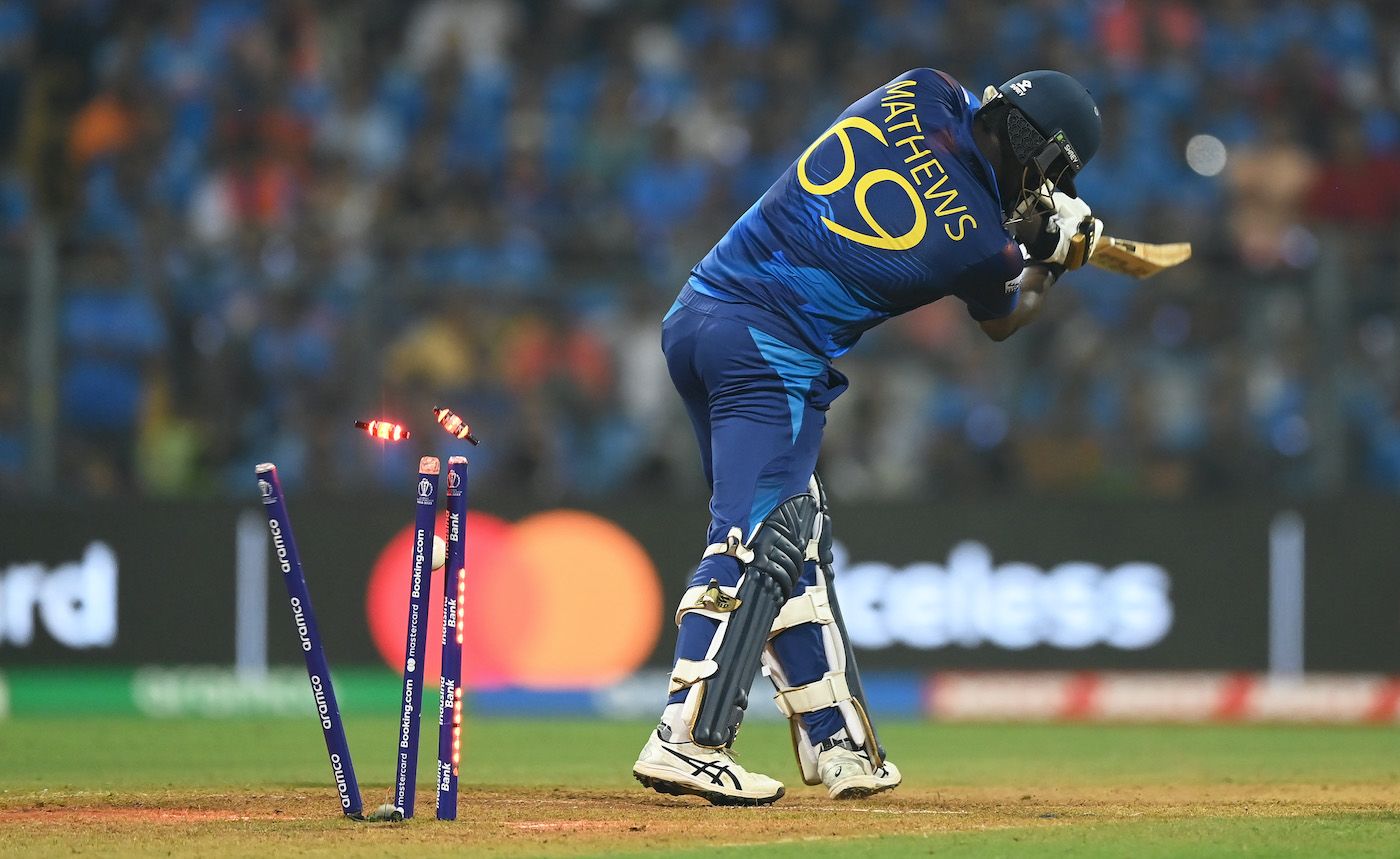

How do you possibly play that? How do you prepare for a ball that vicious? How many hours of batting in the nets does it take? How many sets of how many reps of weights to condition the muscles? How many hours on treadmills and cycles to strip the fat that might slow you down?
How many coaches must take a look, poring over how much footage, of how many balls faced, from how many angles?
It was a ball that had to pitch almost exactly at that length to have Rohit pinned on the crease, had to be bowled at almost exactly that speed to be quick enough to beat Rohit and still take the deviation off the pitch, and had to land on almost exactly on that line to take off stump.
A magic ball.
The kind that – from your earliest days of surging in, bracing your front leg, and whipping your body through your action – you dream of bowling. Even just once in a lifetime.
But these are not normal circumstances, and Sri Lanka are not facing a normal attack.
It is almost forgotten amid the sheer admiration these deliveries elicit, that both batters have reviewed these decisions, refusing to believe the angles. The wickets raise six roars from the exulting Wankhede – once each when the stadium goes up in appeal with the bowler, once each when the lbw is given, once each when confirmed on review.
More come in quick succession. Siraj has one swing away late again, draws another batter into another false shot, but the batter is not good enough to edge it. Later in the over, knowing he is in a desperate fight, Sadeera Samarawickram comes out of the crease and tries to hit Siraj off his length. Siraj just pulls it back, pitches it wider, gets Samarawickrama’s edge anyway.
In Siraj’s next over, more sorcery first ball, angled in, swinging late, seaming away, hitting the top of Kusal Mendis’ off stump, breaking the bail. This is after Bumrah bowled an over in which he had struck Mendis on the pad with a wicked ball that jagged, and after Bumrah had beaten Mendis’ edge with an awayswinger.
The crowd is watching an opposition fail to put up even a semblance of a fight. But they are out of their seats anyway, slapping thighs and backs, gasping when the ball whizzes past the edge, living every electric moment. They are, like the batters themselves, in thrall. In thrall of a group of bowlers who are stringing magic balls together, bowling magic overs, turning them into magic spells. At one stage, it seems as if there are more dazed and dismissed batters in the Sri Lanka dressing room than there are runs on the board.
This is a batting line-up that has twice crossed 320 this tournament, have a batter averaging 66.20, another who had hit four consecutive fifties and a 46 in the World Cup, and in Mathews a player with 193 ODI innings and some all-time great knocks on his record. Collectively, there are tens of thousands of hours of batting practice here, hundreds of coaching hours just in the last three months, and decades of knowledge in the dressing room.
But India have seven in a row now. Their quicks have KOed a top order for the second time in a row. And they have now blasted Sri Lanka out for well under a 100 for the third time this year.
They can do all this, defy all this history, make batting orders question how they can possibly be played, and rack up incredible numbers, because there is a sense emerging now: the attack might be once in a lifetime.
Andrew Fidel Fernando is ESPNcricinfo’s Sri Lanka correspondent. @afidelf