
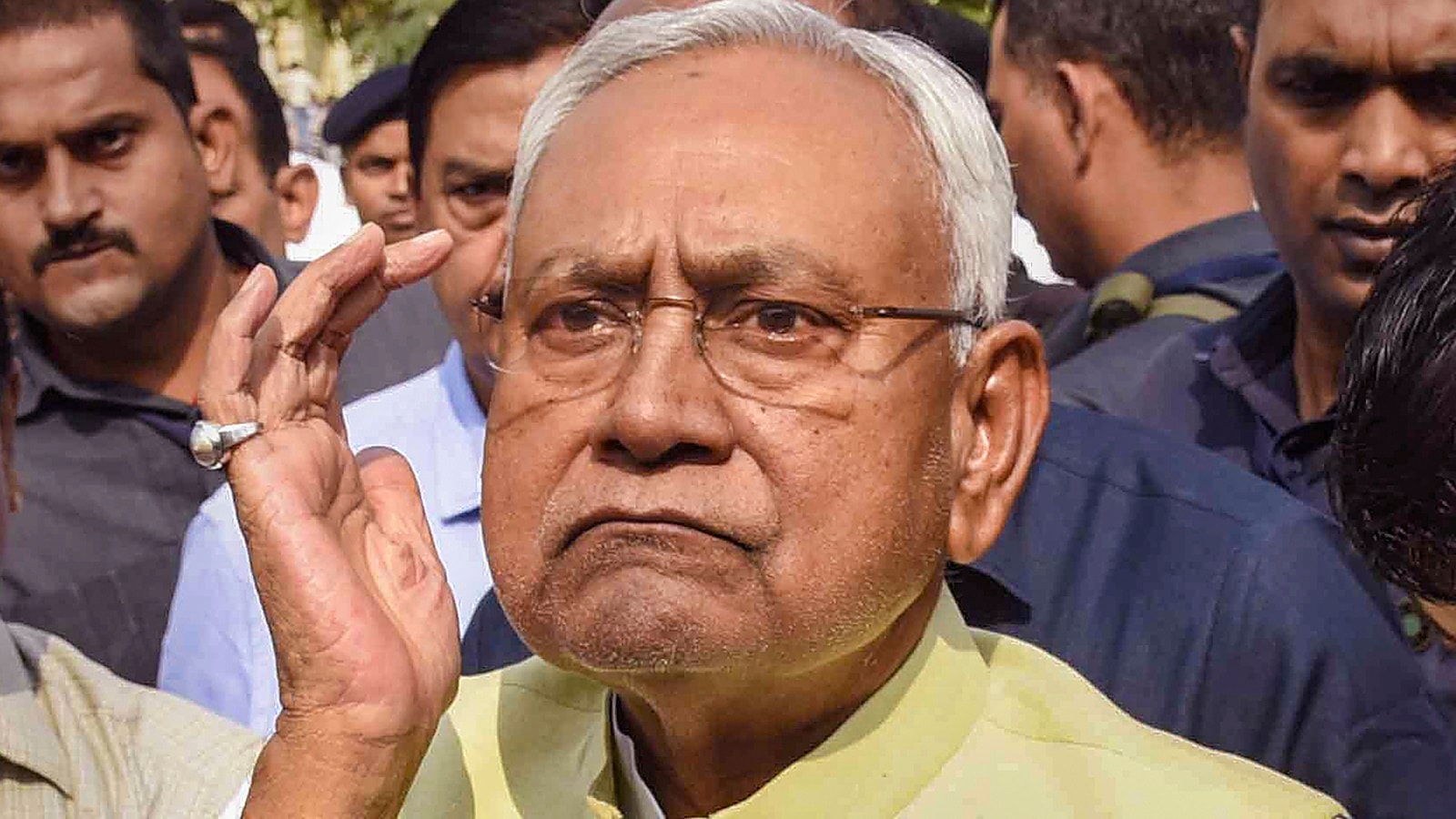

Ever since Nitish Kumar made his inappropriate remarks on birth control in the Bihar Assembly, there have been many exclamations and expressions of disgust. Worthies have wrung their hands and raised their fists, appalled at this abominable low in public discourse.
Leading the charge was Prime Minister Narendra Modi, who at a rally in Madhya Pradesh’s Guna said, “One of the big leaders of INDI Alliance, who roams around with the flag of their alliance… that leader said indecent things in the Assembly, where mothers and sisters were also present… He doesn’t have any shame… Those who have such an attitude towards mothers and sisters, can they ever do good for you? How low will you stoop? And you are humiliating the country in the world. My mothers and sisters, I will not back down and will do whatever possible for your respect.”
The same rhetoric, about the Bihar CM disrespecting women — more specifically, “mothers and sisters” — has been repeated by many BJP leaders.
But here’s the thing: While what Nitish said is undoubtedly crude and graphic, it in no way insults women. The idea that anything related to sex insults “mothers and sisters” is rooted in patriarchy.
When considering a “vulgar” remark, the context in which it was uttered is important. Nitish was speaking about the relative autonomy over reproduction that educated women have, and it is an important and valid point. He was not smirking and looking at women while he said so, he was elaborating upon his argument, although without the proper vocabulary to do so. Even the Supreme Court, in a 2014 obscenity trial, had pointed out that the potentially obscene material has to be “taken as a whole” and seen within the context of what it wants to convey.

As stated earlier, the remarks are indeed crude and rather juvenile. But crassness is equally distasteful to anyone, regardless of their gender. Where does the question of insulting women come in? From the idea that the fairer sex is too delicate to hear all things carnal, lest it corrupt their innocent minds.
The whole rhetoric of “mothers and sisters” is based on the patriarchal notion of “honour”, the one concept that has done the most disservice to women. It is this notion of honour that is behind our society’s collective failure to grow up about sex. It reduces all conversations about sex to something vulgar and salacious, not meant for respectable women like “mothers and sisters”, and prevents much-needed dialogue on safe sex and birth control.
Nitish Kumar talked of educated women asking their husbands to pull out before ejaculation, so as to prevent unwanted pregnancies. He said this can control population. The point is very much about women empowerment, about giving women information and control over their reproductive decisions. To see something prurient and suggestive in this — which would definitely have been offensive — simply shows that in the listener’s repressed mind, any straight talk about sex is automatically dirty talk.
Most Read
Kolkata or Mumbai, where will India play their World Cup semifinal? Depends on who they face
Aamir Khan charged Rs 25 lakh for a commercial, Shah Rukh Khan was ready to do it for Rs 6 lakh as he wanted to buy Mannat: Prahlad Kakkar
This, of course, is related to another issue: the extreme difficulty of having a conversation in Hindi about sex, without sounding like an incomprehensible Biology textbook or a C-grade movie character. North India is among the most populous regions of the most populous nation in the world. If the dominant language here lacks the vocabulary for holding non-squirmy conversations about birth control, it shows how enmeshed in shame and honour sex still is. And the brunt of this is of course borne by women, made to bear child after child without being physically, emotionally, or financially up to it. We need more political leaders to talk about sex and birth control, and it is shushing such conversations that actually harms “mothers and sisters”.
Much worse has been said about women by political leaders before this, and the fact that the heaviest of our political heavyweights chose to lend his weight to this raises a Rs 50-crore question: Are remarks that outrage the patriarchal notion of our modesty really a bigger problem than those that outrightly attack our bodies, autonomy, and rights as equal human beings?
This is not to say Nitish Kumar deserves no blame at all. He is a seasoned politician who has tailored policies for women throughout his tenure. He should have known he was making an important point, and should have made the effort to come up with an effective — and scientifically accurate — way to make it. His words, his laughter, and silly hand gestures have deflected attention to something else altogether, and the row will possibly prevent other politicians from raising similar issues. Amid the massive backlash, the Bihar CM has apologised with folded hands. The only saving grace is he did not direct his apology to “mothers and sisters” alone.
yashee.s@indianexpress.com