
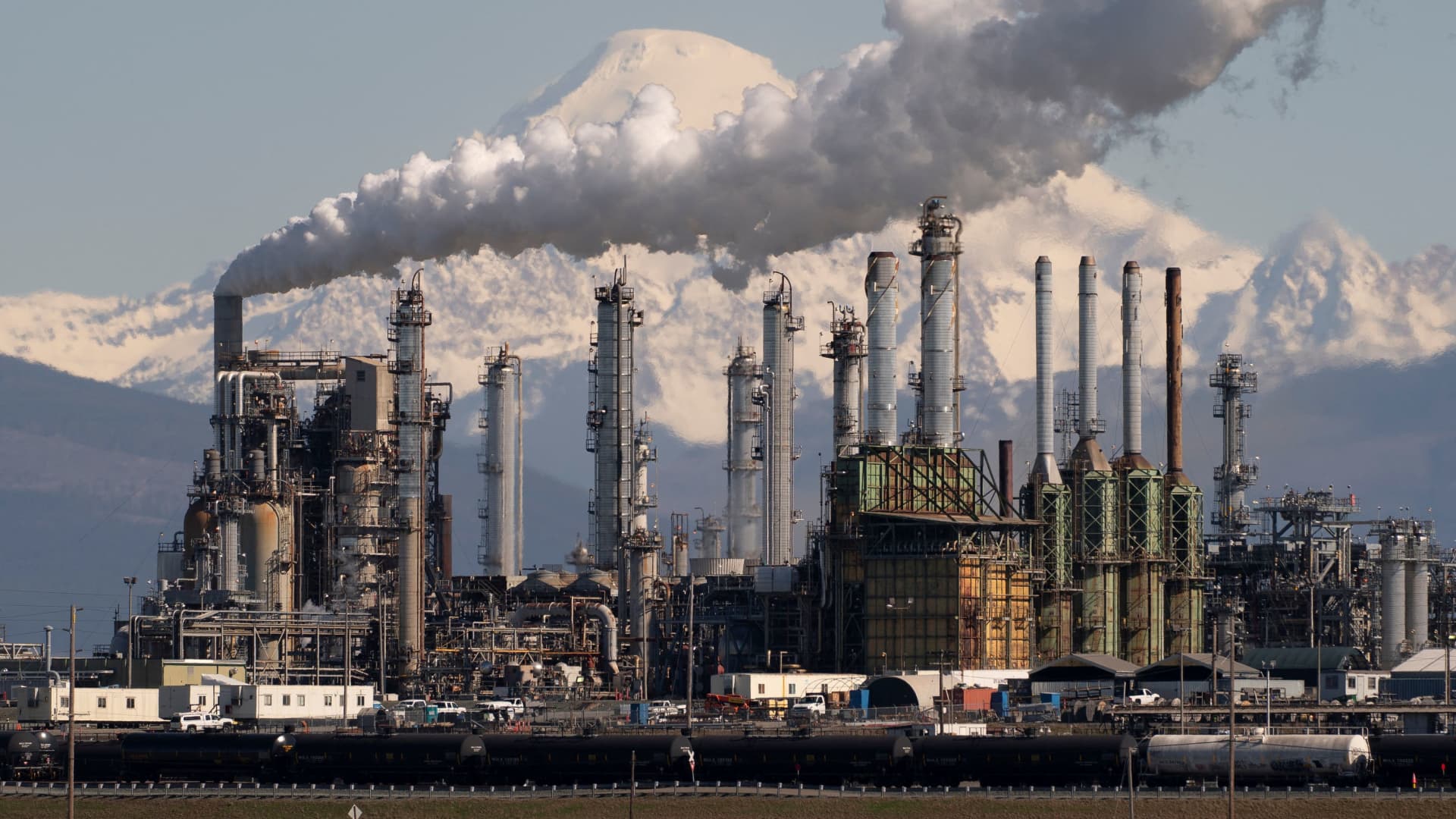

Marathon Petroleum’s oil refinery in Anacortes, Washington.
David Ryder | Reuters
Energy heavyweights Chevron and Exxon Mobil announced shiny new acquisitions this month — and some industry watchers say it could be the start of more multibillion megadeals to come.
Chevron on Monday said it’s buying Hess for $53 billion in stock, allowing Chevron to take a 30% stake in Guyana’s Stabroek Block — estimated to hold some 11 billion barrels of oil.
The announcement comes just weeks after Exxon Mobil announced its purchase of shale rival Pioneer Natural Resources for $59.5 billion in an all-stock deal. While this marks Exxon’s largest deal since its acquisition of Mobil, the merger would also double the oil giant’s production volume in the largest U.S. oilfield, the Permian Basin.
“The big-money acquisition of Hess by Chevron accelerates the trend of consolidation and big-money deals,” energy consultancy Rystad Energy said in a note.
Although Chevron’s acquisition is the continuation of a story started by the Exxon-Pioneer deal, its motivation and impact is slightly different, the note stated.
Exxon is zoning in on its core operations in the Permian basin, while Chevron has decided to expand into where it does not yet have existing assets: Guyana and the Bakken shale.
These megadeals are just a prelude to this large investment wave I expect in coming years.
Bob McNally
President of Rapidan Energy Group
Kpler’s economist Reid I’Anson said the Exxon-Pioneer deal is “likely a bit less risky” compared to the Chevron-Hess deal.
Exxon will see more immediate returns and Pioneer alone would add 711,000 barrels per day, he said comparing it to just 386,000 barrels per day from Hess.
“However, the Chevron acquisition likely has more upside given the future production growth potential out of Guyana,” he noted.
That said, both Exxon and Chevron’s megadeals are indicative of a larger, overarching ambition.
The two oil giants plan to continue pumping investments into fossil fuels as demand for crude remains strong, especially amid tightening global supplies fueled by years of chronic underinvestment.
Consolidation has been a focus in the North American shale space in the past year, especially in the Permian basin where larger exploration and production (E&Ps) have “swallowed up” smaller operations in the bid to bolster drilling inventories and boost free cash flow, Rystad’s senior shale analyst Matthew Bernstein told CNBC.
Silhouette of Permian Basin pumpjacks taken at dusk, north of Midland, Texas, U.S. in late 2019.
Richard Eden | via Getty Images
The upstream segment of the oil and gas industry refers to the exploration for oil or gas deposits, as well as extraction and production of those materials.
The Permian basin is a shale patch that sits between Texas and Mexico, which saw a slew of deals this year.
“These megadeals are just a prelude to this large investment wave I expect in coming years,” Bob McNally, president of Rapidan Energy Group, told CNBC via email. With Exxon deepening its presence in the U.S. shale sector, and Chevron’s eyes on Guyana, the two deals will instill more confidence in the wider oil industry to overcome any hesitation and invest in oil and gas, McNally continued.
“These deals signify the shift from a multi-year bust phase in oil that began in 2014 to a multi-year boom phase that should last well through this decade,” he forecasts.
No peak demand for oil just yet?
The deals by the two largest publicly traded major oil companies appear to confirm that crude oil demand will remain strong over the long term, said Andrew Woods, Mintec’s industrial analyst.
Dan Pickering, founder of Pickering Energy Partners, echoed similar sentiments, saying that both energy behemoths believe oil demand has not yet peaked.
On Tuesday, the International Energy Agency reported that demand for oil, coal and natural gas is set to peak before the end of