
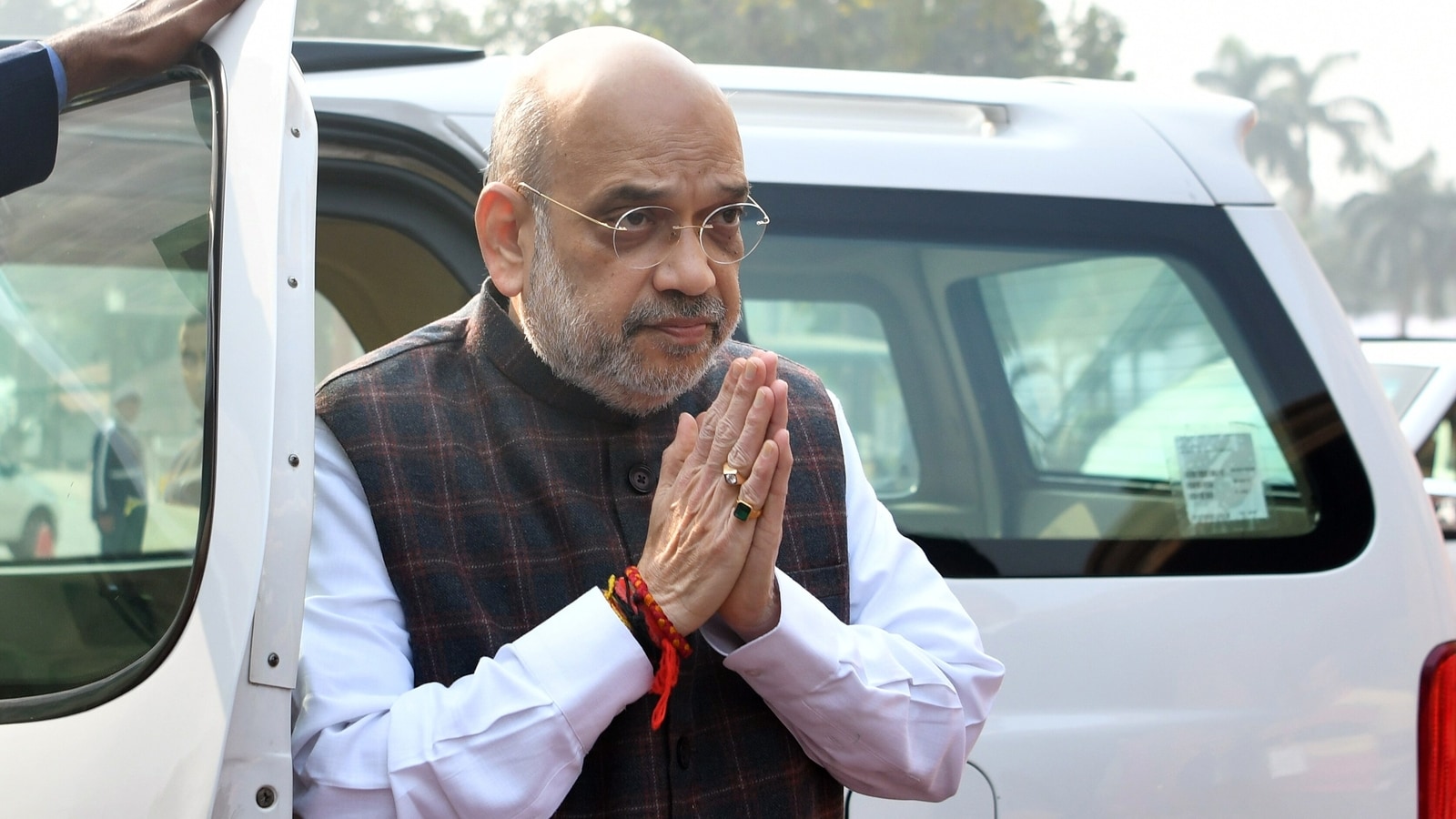

Union Home Minister Amit Shah on Tuesday lashed out at the Opposition for calling the Bharatiya Janata Parrty’s agenda of Ram Mandir, abrogation of Article 370 and Uniform Civil Code (UCC) as communal and divisive, asking if they were calling the Supreme Court, which paved the way for the Ram temple with a landmark 2019 verdict and upheld the scrapping of Article 370 this week, communal.
In his intervention during the debate on the bills for women reservation in Jammu and Kashmir, and Puducherry assemblies, Shah refuted the Opposition on UCC and questioned if India’s first President and the head of the Constituent Assembly, Rajendra Prasad, was communal for putting UCC in the directive principles of state policy.
The non-binding Article 44 of the Constitution says, “The State shall endeavour to secure for the citizens a uniform civil code throughout the territory of India.”
During the debate on the Jammu and Kashmir Reorganisation (Second Amendment) Bill and The Government of Union Territories (Amendment) Bill, Trinamool Congress leader Saugata Ray called the BJP’s core agenda of building a Ram Mandir, rolling out UCC and the abrogation of the Article 370 as communal and divisive.
The two bills were later cleared by the Lok Sabha.
Read Here | Article 370 abrogation in J-K constitutionally valid: Supreme Court backs Centre in landmark verdict
Shah who listening to the debate, challenged Ray’s argument.
“I am replying to the lies peddled in this House…He (Ray) dubbed three issues as communal. The apex court of this country had ordered that a Ram Mandir would be constructed. Is the MP trying to say that the apex court of this country give communal judgements? The apex court has fully approved the decision to abrogate Article 370. Re you trying to say that a communal decision has got the court’s approval. Thirdly, the Constituent Assembly has given us a directive that the UCC should be implemented at some point. Are you trying to say that the Rajendra Prasad-led Constituent Assembly used to give communal directions?”
The home minister also retorted when Congress floor leader Adhir Ranjan Chowdhury provoked him to bring back Pakistan-occupied Kashmir (PoK) and Aksai Chin. “You are a powerful person. You have made tall claims. When are you going to bring PoK and Aksai Chin? I challenge Modi and Amit Shah, bring back PoK where China is building roads,” Chowdhury said.
“You are asking us to bring PoK and Aksai Chin. I want to ask you, who was in power when PoK and Aksai Chin was taken over?” Shah said.
He also reminded members that had Syama Prasad Mookerjee, the founder of the Jana Sangh, not started the Banga-Bhanga movement, “Bengal would have not stayed in India.”
Read Here: Unanswered question in the Article 370 order
While the Congress, TMC and many other parties supported the extension of women reservation in J&K and Puducherry assemblies, many leaders wanted to know when the government planned to hold elections in J&K and restore its statehood.
Initiating the debate, Chowdhury said “SC has said the J&K assembly polls should take place. Why can’t the elections be held earlier? It is not necessary that polls will be held only after SC tells you to do so. Why don’t you restore the statehood too?” In its judgment on Monday, the top court had asked elections to be held by September 30.
He also questioned why Mookerjee was apart of the government (of erstwhile Bengal province in British India) with Fazlul Haq.
There were some lighter moments during the debate too. While Ray said that his party had asked him to oppose whatever Shah said, the home minister quipped, “I will never say that Trinamool should win, but if I say so, they will lose the election.”
Later, replying to the debate, minister of state for home Nityanand Rai maintained that the new laws will enable greater representation and participation of women in the law-making processes in the J&K and Puducherry assemblies.
Rai also attacked the Congress “During the Mughal rule, reign of aggressors, the British rule or during the rule of Congress, rights of the women were taken away and they were never got adequate opportunities.”
The junior minister also pointed out to some of the benefits given to women in J&K and said, “after Article 370 was abrogated, widow pension has reached 100% coverage in J&K. One-stop centres for the benefit of women have come up in every district of the Union territory.”