
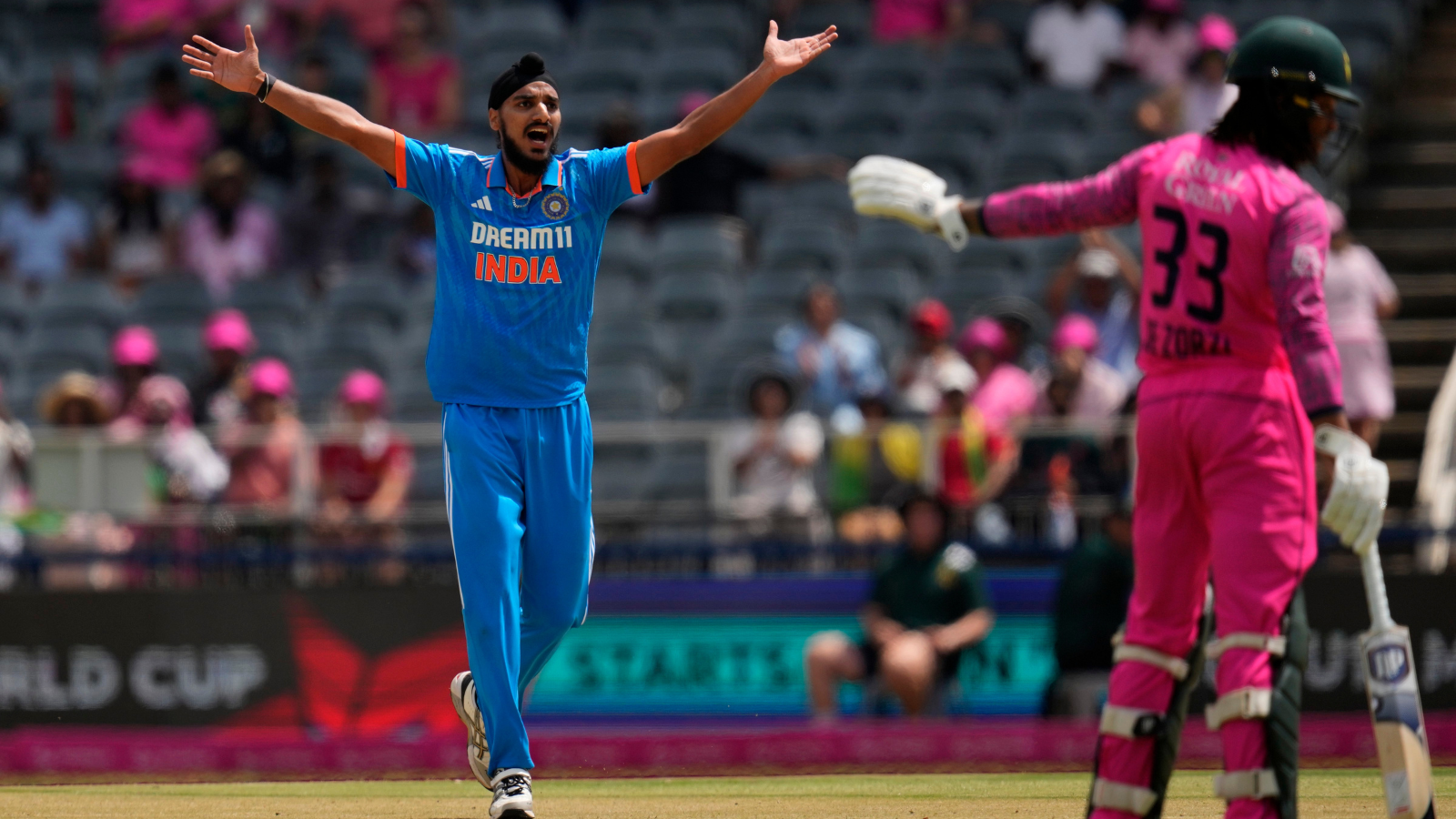

The depth of India’s fast bowling is dizzying. The blue-chipped pace trio of Jasprit Bumrah, Mohammed Shami and Mohammed Siraj, the batsmen-wreckers of the World Cup gone by, were nowhere to be seen in the Bullring. Bumrah and Siraj are preserving themselves for their country’s latest tilt at winning a Test series in South Africa; the hard labour of a frantic year took its toll on Shami’s body. Thrown, thus, into the deep end were a trio with a collective register of nine games and five wickets.
But on a surface with variable bounce, lateral movement in the initial overs and sufficient pace, the callow pair of Arshdeep Singh and Avesh Khan sufficed, sharing nine wickets between them, and consigning the hosts to their lowest ever total at home, a meagre 116, which India’s batsmen hunted down with minimal fuss, with 200 balls to spare and eight wickets in tact. No one would have anticipated them to sting as painfully as they did.
In a 30-minute opening spell, he justified the wisdom of selectors’ persistence despite his scattergun reputation. Perhaps, the 50-over game suits his craft more than T20s. The shortest format is a hot furnace from the start —the first two overs, the first spell, that’s the game. The 50-over variant is where he could be self-contained, where he could resist the urge to experiment with seam positions and speed, where he could bowl the way he wants to, where he gets time to probe and experiment, to find out what this ball is capable of and locate the right length on this pitch. Or when he could bowl with a clear head. When he bowls with a free and clear mind, when he is undisturbed about leaking boundaries, un-obsessed about landing every ball on the toes, everything else falls into place, The run-up is smooth, he glides through the crease with a fluid motion of his limbs, the release is uncluttered, the wrist comes down nicely, the ball comes off his palms as his mind has designed.
Suddenly everything fell into place. He consumed Rassie van der Dussen with a Boult-ish in-swinger, swerving away in the air, and shaping back to thrash his pads. An inch fuller in length, he would have completed a hat-trick. But the shorter length meant that even though the ball swung back to hit the pads of Aiden Markram, the ball would whistle over the bails. He would then beat his outside edge as well as hurry him into pulling — he has an under-appreciated short ball, which is sharp, fast and awkward. Markram counterpunched with a six and four, but Arshdeep didn’t taper off.
Arshdeep would take a breather after his first spell, but there was no room to breath for South Africa, as Avesh Khan came breathing down them with his pace and seam movement. Avesh did what Shami famously did in the World Cup, to trade successive blows to knock the opponent out of the game. Like Arshdeep, Avesh’s career too has not yet taken. His virtues are obvious — he has pace, he could extract inward movement and make the ball hold its line. There are gifts to make a decent enough career, but he has been erratic like Arshdeep, or more suitably, a young Umesh Yadav, with bustling energy and robust physique.
From 73 for 8, a comeback route was nigh impossible. From then on, it was a question of who among Avesh and Arshdeep would pinch their maiden five-for. Arshdeep would be the one, when he dismissed Andile Phehlukwayo, the lone fighter among South Africa’s batsmen (33 off 49), but it was an afternoon the coffers of India’s bank of reverse bowlers overflowed. No Bumrah, Siraj, and Shami. Well, no problem.