
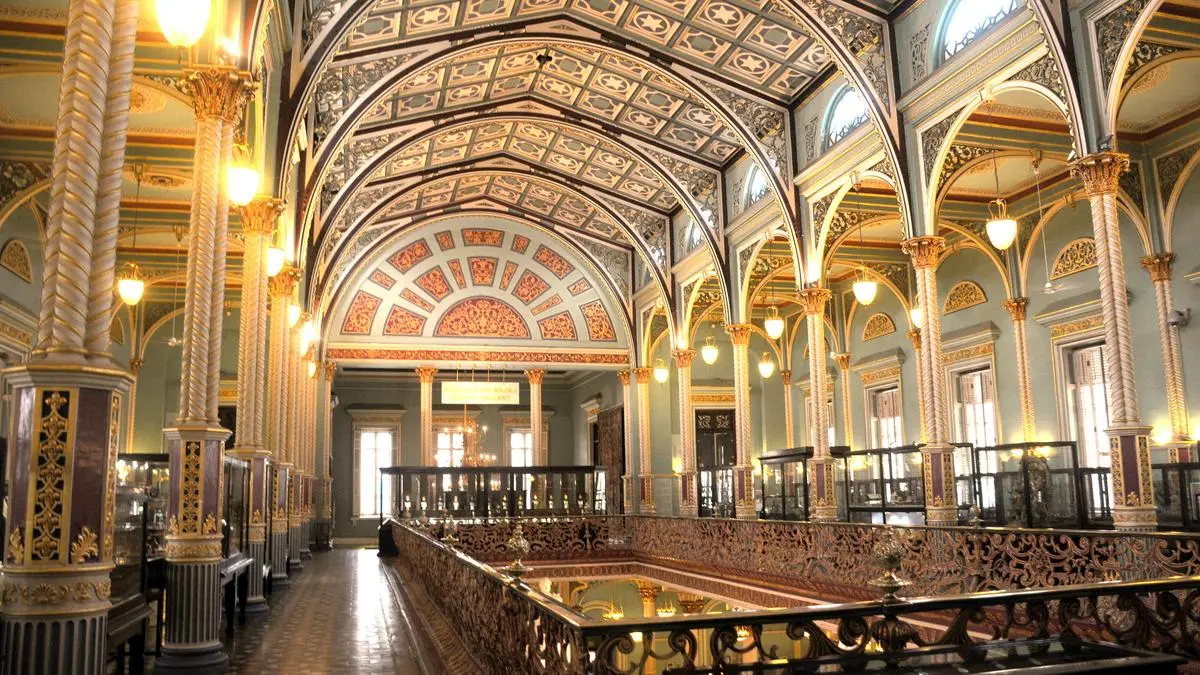

On International Museum Day on May 18, 2017, a view of Mumbai’s Dr. Bhau Daji Lad Museum was captured. The museum, designed in the Palladium style, boasts a lavishly decorated Victorian interior. It received the UNESCO Asia Pacific Award in 2005 for its impressive restoration work. It is one of two iconic landmarks in Mumbai, along with Chhatrapati Shivaji Maharaj Vastu Sangrahalaya (CSMVS), that are celebrating their 150th and 100th anniversaries respectively this year. Despite their prestigious status, these museums strive to be inclusive by offering affordable entrance fees starting at Rs.10.
Located in the botanical gardens of Byculla, Dr. Bhau Daji Lad Museum is situated in one of the oldest areas of Mumbai, where influential government officials resided during the British era. The museum exclusively focuses on Mumbai’s history, culture, people, and artifacts, providing insights into the city’s past through its exhibitions and skilled craftsmen. Established in 1857 by Dr. George Birdwood, Sir Jamsetjee Jeejeebhoy, Dr. Bhau Daji Lad, the Honorable Jugonnath Sunkersett, and Dr. George Buist, it showcases maps depicting the evolution of Mumbai, from its origins as a group of seven islands to its development as a bustling port city. The museum’s garden features statues from various parts of Mumbai that were collected during the Samyukta Maharashtra Movement in the late 1950s.
CSMVS, known for its elegant dome, forms an integral part of Mumbai’s skyline. Situated in the historic Kala Ghoda area, formerly Bombay Fort, it was initially named the Prince of Wales Museum. Scottish architect George Wittet designed the CSMVS in the Indo-Saracenic style. Influential figures in the city such as Sir Pherozeshah Mehta, Sir Ibrahim Rahimtoola, and Sir Vithaldas Thackersey envisioned a museum that actively educates its visitors rather than merely showcasing artifacts. This educational ethos remains central to CSMVS. In 1905, the Bombay Presidency granted a plot of land for the museum’s construction, on the condition that funds would be raised by the public, who would also be responsible for maintaining the museum.
CSMVS operates as an autonomous institution, without government aid, showcasing its success as a community-driven model over the last century. In 2010, it received the UNESCO Asia Pacific Heritage Award for Cultural Heritage Conservation. In 2018, it was declared a UNESCO World Heritage site, forming part of Mumbai’s Victorian Gothic and Art Deco ensemble. Additionally, it was awarded the UNESCO Asia Pacific Awards’ Award of Excellence in November 2022. The Bhau Daji Lad Museum also won UNESCO’s highest restoration award in 2005.
Both the Bhau Daji Lad Museum and CSMVS required structural restoration due to their age. Vikas Dilawari, a renowned architect specializing in heritage conservation, had the privilege of overseeing the restoration projects for both museums. The Bhau Daji Lad Museum posed a greater challenge due to its prior neglect. Dilawari recalls the state of disrepair, including broken glass, outdated electrical wiring, and a lackluster appearance. However, with substantial archival information, the restoration team, led by Dilawari and conceptualized by Tasneem Mehta, was able to restore the museum to its former glory, reviving dying arts such as lime mortar repairs and gilding.
The CSMVS, being relatively younger and better maintained, underwent regular restoration work over the years. As the centenary celebrations approached, further restoration efforts were undertaken, including repairs to the dome, façade, and European painting storage areas. During the lockdown, limited restoration work took place, with a remarkable achievement being the erection of an elaborate scaffolding 110 feet high for internal dome repairs. The enforced closure also provided an opportunity to refurbish busy areas like the entrance lobby, verandas, and some key galleries, showcasing the museum’s Indo-Saracenic character through skilled craftsmanship.
In summary, both the Dr. Bhau Daji Lad Museum and CSMVS have reached significant milestones in their respective anniversaries. These iconic landmarks required extensive restoration, overseen by architect Vikas Dilawari. The Bhau Daji Lad Museum’s restoration project, conducted through a public-private partnership, received UNESCO’s Asia Pacific Award in 2005. The CSMVS, operating as an autonomous institution, has undergone regular restoration work and received multiple accolades, including the UNESCO Asia Pacific Heritage Award and World Heritage site designation. Dilawari’s comprehensive restoration approach revitalized these museums, preserving their cultural heritage and reviving forgotten artistic techniques.