
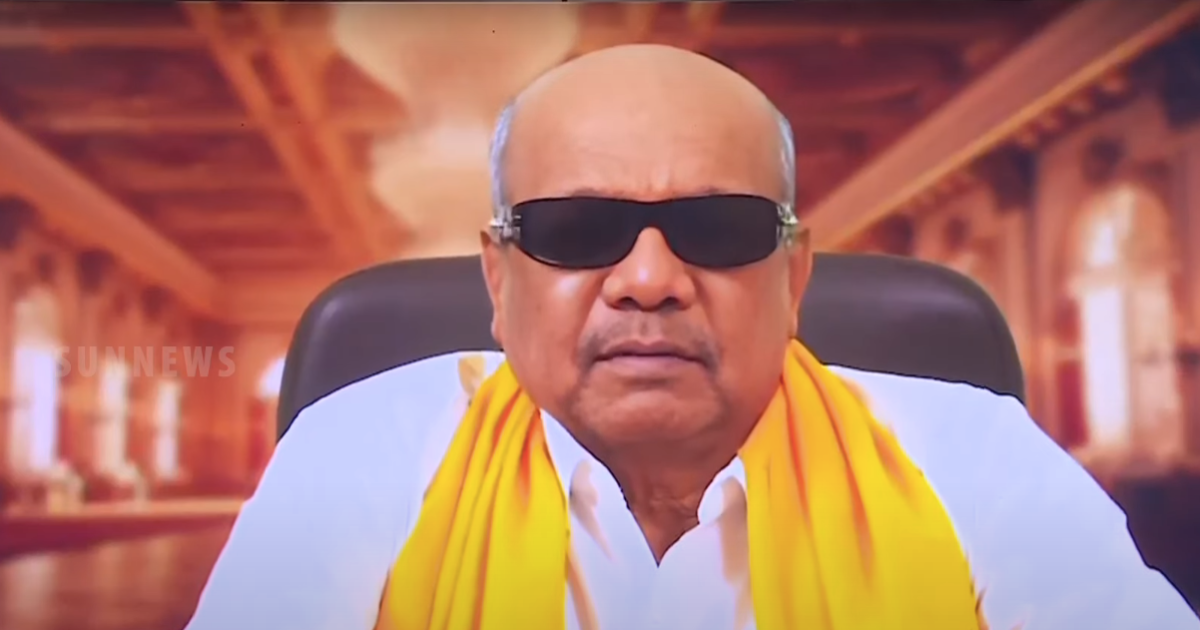

In Bengaluru, India on January 23, a large projected screen featured an icon of Indian cinema and politics, M Karunanidhi, who congratulated his 82-year-old friend and fellow politician TR Baalu on the launch of his autobiographical book. Karunanidhi was dressed in his characteristic black sunglasses, white shirt, and a yellow shawl around his shoulders as he appeared before a live audience. In his eight-minute speech, the veteran poet-turned-politician not only congratulated the book’s author, but also spoke highly of the able leadership of his son and the current leader of the state, MK Stalin.
Karunanidhi has been dead since 2018, but this was the third time in the past six months that the iconic leader of the Dravida Munnetra Kazhagam (DMK) party was resurrected using artificial intelligence (AI) for such public events. The AI media tech firm that created the deepfake Karunanidhi video, Muonium’s founder Senthil Nayagam, stated that there is a growing market for such deepfakes. He explained that attributing specific statements to a particular person gives more value to them.
AI Karunanidhi made his first public appearance at a local media event last year in September, and has since been used for a campaign by his party members. The AI leader often praises the leadership of his son MK Stalin at public events and seeks to boost his popularity. At the January book launch, AI Karunanidhi praised the achievements of his son MK Stalin, including female-friendly policies, roping in investments, and more, aiming to highlight the progress of the state under his leadership.
Senthil Nayagam used publicly available data of Karunanidhi to train a speech model and recreate the likeness of the leader from the 1990s when he was much younger. The script for the prerecorded AI speech was supplied by the local DMK cadre and vetted by party personnel. TR Baalu, whose team sanctioned the creation of AI Karunanidhi, did not respond to Al Jazeera’s request for comment.
As interest in such applications ballooned, it was revealed that there is a market opportunity in AI electioneering in India this election year, estimated at $60m. The possible misuse of artificial intelligence to influence public opinion has caused concern, with many instances of the use of AI for campaigning and instances of misuse having gained prominence in South Asia.
Ahead of the Indonesian presidential campaign, Prabowo Subianto, a former military general, used generative AI to reimagine himself as a chubby-cheeked AI avatar. In South Asia, AI’s use for campaigning and instances of misuse has gained prominence, with pro-government accounts in Bangladesh using deepfakes to target opposition parties. In Pakistan, former Prime Minister Imran Khan has been campaigning from inside his prison cell by passing on written notes to his lawyers, which are being turned into AI audio speeches using software from a US-based start-up ElevenLabs.
The DMK party used AI Karunanidhi at its second annual youth wing conference in January, where the deepfake video speech concluded with AI Karunanidhi calling for the strengthening of the state’s rights and urging young cadres to fight for a democratic future. DMK spokesperson Dharanidharan Selvam stated that the video was created by the party’s digital media wing to encourage and enthuse the cadres. Political commentator Sumanth Raman remarked that deceased leaders are in vogue for political campaigns because they continue to be more popular than living ones.