
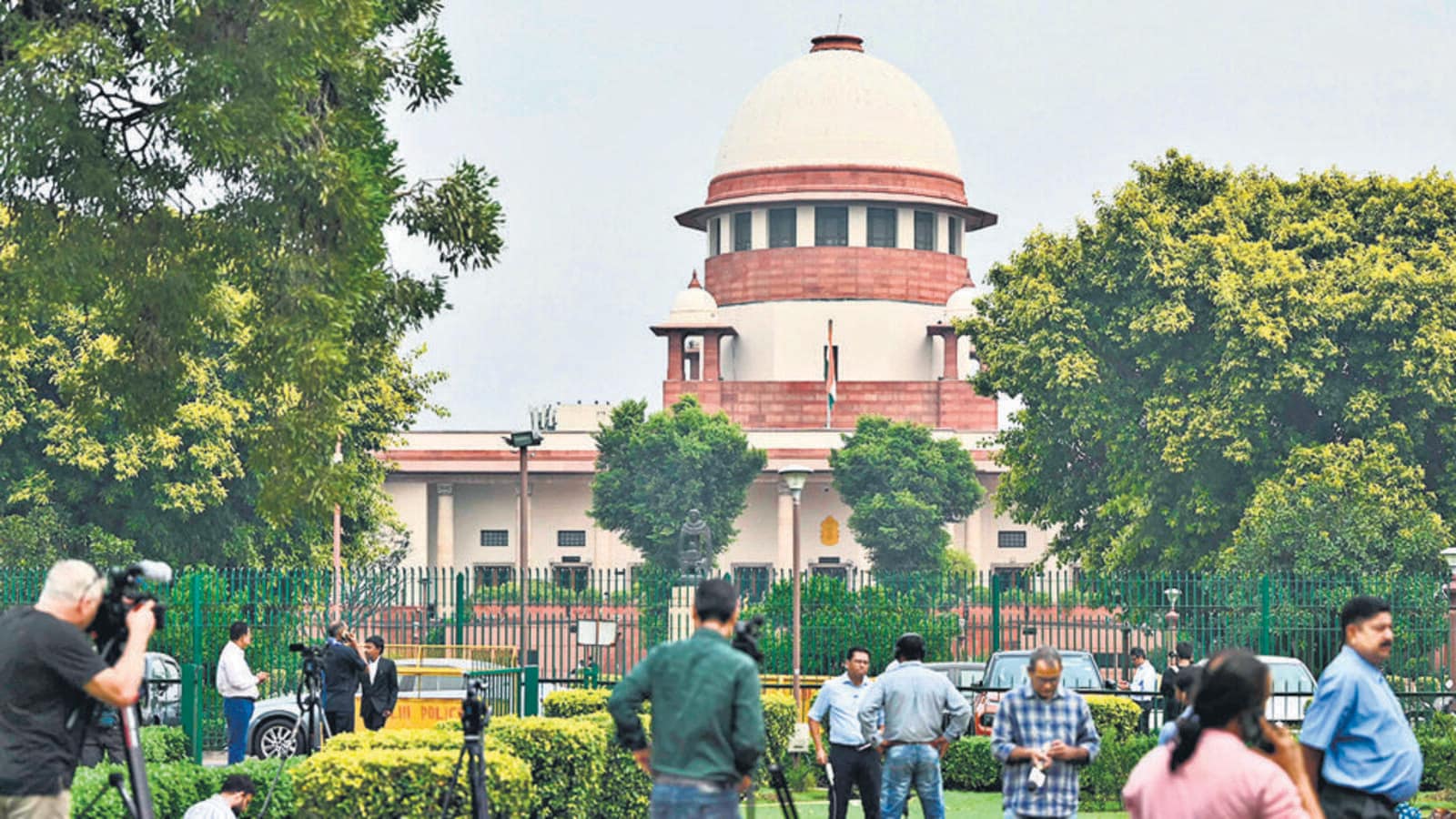

The Supreme Court on Thursday struck down the Centre’s 2018 electoral bond (EB) scheme of political funding, declaring it to be “unconstitutional” because it completely anonymised contributions made to political parties and added that restricting black money or illegal election financing — some of the articulated objectives of the scheme — did not justify violating voters’ right to information in a disproportionate manner.
Ordering full disclosure of donors and recipients of EBs issued since April 2019 on the website of the Election Commission of India (ECI) by March 13, a five-judge Constitution bench, headed by Chief Justice of India (CJI) Dhananjaya Y Chandrachud, ruled that amendments made in the Representation of the People Act, Income Tax Act, and Companies Act through the 2017 Finance Act violated the constitutional right of the electors to access information on the funding of political parties “which is necessary to identify corruption and quid pro quo transactions and governance information”.

The verdict came ahead of the Lok Sabha elections expected to take place in April or May this year and was immediately welcomed by opposition parties — since the inception of the scheme, the Bharatiya Janata Party (BJP), in power at the Centre since 2014, has received 54.8%of the electoral bonds purchased in this period — and civil society activists.
Welcoming the verdict, Congress president Mallikarjun Kharge said the party had called the scheme “opaque and undemocratic” when it was launched. Subsequently in its 2019 manifesto, he added, the Congress promised to scrap the “Modi government’s dubious scheme”.
“We welcome the decision of the Supreme Court today, which has struck down this ‘Black Money Conversion’ scheme of the Modi Government, calling it ‘Unconstitutional’,” Kharge said in a post on X.
Association for Democratic Reforms (ADR), one of the petitioners in the electoral bond case, said they welcomed the verdict.
“We welcome this landmark judgement wholeheartedly. The Supreme Court has given a big boost to Indian Democracy, something our freedom struggle fought for. ADR is privileged to have played a small role in carrying that legacy forward,” Trilochan Sastry, chairman, founder member and trustee of ADR, said.
The government, HT learns, is studying the judgment. It’s options, people familiar with the matter said, are to accept the verdict, take the ordinance route, or seek a review. To be sure, the verdict affects all political parties, and the regime in power does always end up getting the bulk of contributions, irrespective of the mechanism.
The Bharatiya Janata Party (BJP) played down the verdict, saying it foresees no negative impact on voters’ sentiment.
EBs, which are bearer banking instruments that do not carry the name of the buyer or payee, go for sale in 10-day windows in the beginning of every quarter— in January, April, July and October — besides an additional 30-day period specified by the central government during the Lok Sabha election years.
The court was emphatic that the scheme violated the right to information.
“The electoral bond scheme and the impugned provisions, to the extent that they infringe upon the right to information of the voter by anonymizing contributions through electoral bonds, are violative of Article 19(1)(a)…Electoral bonds provide economically resourced contributors who already have a seat at the table selective anonymity vis-à-vis the public and not the political party,” said the bench, also comprising justices Sanjiv Khanna, BR Gavai, JB Pardiwala and Manoj Misra.
And it did not buy the government’s argument that it was needed to clamp down on black money.
The court said that the Union of India has been unable to establish that EB scheme employs the “least restrictive means” in balancing the right to information of the voter and the right to informational privacy of the contributor, citing electronic transfers and creation of electoral trusts as alternatives to balance “informational privacy of donors”, which it held extends to financial contributions to political parties.
“The Electoral Bond scheme is not the only means for curbing black money in electoral finance. There are other alternatives which substantially fulfil the purpose and impact the right to information minimally when compared to the impact of electoral bonds on the right to information,” said the top court.
While the CJI penned the judgment on behalf of himself and justices Gavai, Pardiwala and Misra, justice Khanna authored a separate but concurring judgment.
Permitting unlimited corporate contributions to political parties was also “manifestly arbitrary and violative of Article 14 (right to equality)”, the bench further said, as it highlighted that the rule authorized unconstrained influence of companies in the electoral process. “This is violative of the principle of free and fair elections and political equality captured in the value of one person-one vote,” added the top court, emphasising a “close nexus between money and politics”.
By March 13, the court ordered all fundings received by political parties since April 12, 2019 — when it issued an interim direction to the parties to submit such information with the ECI, till date shall be made public by putting the information on the ECI’s website.
It directed the State Bank of India— the only designated EB-issuing bank — to forthwith stop the issuance of EBs, adding the bank will submit details of EBs purchased since April 12, 2019, till date to the poll body by March 6.
“The details shall include the date of purchase of each Electoral Bond, the name of the purchaser of the bond and the denomination of the Electoral Bond purchased…SBI must disclose details of each Electoral Bond encashed by political parties which shall include the date of encashment and the denomination of the Electoral Bond,” directed the bench.
If EBs are within the validity period of 15 days and are yet to be encashed by political parties, the court ordered, they shall be returned by the political party concerned to the purchaser, depending on who is in possession of the bond to the issuing bank. The issuing bank, upon the return of the valid bond, shall refund the amount to the purchaser’s account, it said.
The judgment authored by justice Khanna underscored that voters’ right to know supersedes anonymity in political party funding, and that the EB scheme fails to meet the balancing prong of the proportionality test.
“The voters’ right to know and access to information is far too important in a democratic set-up so as to curtail and deny ‘essential’ information on the pretext of privacy and the desire to check the flow of unaccounted for money to the political parties. While secret ballots are integral to fostering free and fair elections, transparency—not secrecy—in funding of political parties is a prerequisite for free and fair elections. The confidentiality of the voting booth does not extend to anonymity in contributions to political parties,” said justice Khanna.
The judge added that political contributions for a quid pro quo may amount to money laundering under the Prevention of Money Laundering Act and that “by ensuring anonymity, the policy ensures that the money laundered on account of quid pro quo or illegal connection escapes eyeballs of the public.”
Justice Khanna further called the EB scheme “contradictory and inconsistent” as it let political parties in power to have asymmetric access to information with the authorised bank while also retaining the ability to use their power and authority of investigation to compel the revelation of bonds-related information.
The top court’s judgment came on a bundle of petitions, filed by Association for Democratic Reforms (ADR), non-profit Common Cause, Congress leader Jaya Thakur, and the CPI (M), among others, that had argued that either the scheme must go on account of violating people’s right to know and affecting free and fair elections, or the court ought to direct for full disclosure of the purchasers and donors of EBs. The court’s order has done both.
For the petitioners, senior counsel Kapil Sibal and Vijay Hansaria, along with advocates Prashant Bhushan, Shadan Farasat and Nizam Pasha appeared.
The scheme was defended by the Centre through attorney general R Venkataramani and solicitor general Tushar Mehta, who contended that there cannot be a general right to know everything, that the petitioners had failed to show a larger public purpose of disclosing the identity of the donor, and that there is adequate reason to believe the EB scheme was helping weeding out black money. During the final leg of the arguments in November last year, in response to a question from the bench, the government refrained from making a statement on suitably amending the Companies Act to ensure only profit-making companies could make political donations, which could be capped at a fixed percentage of their profits. The bench, on November 2, reserved its judgment in the matter.
Introduced in 2018, EBs are available for purchase at any SBI branch in multiples of ₹1,000, ₹10,000, ₹1 lakh, ₹10 lakh and ₹1 crore and can be bought through a KYC-compliant account. There is no limit on the number of electoral bonds that a person or company can purchase. Donations made under this scheme by corporate and even foreign entities through Indian subsidiaries enjoy 100% tax exemption while identities of the donors are kept confidential both by the bank as well as the recipient political parties. The public sector bank is obligated under the scheme to disclose the details only pursuant to a court order or a requisition by law enforcement agencies.