
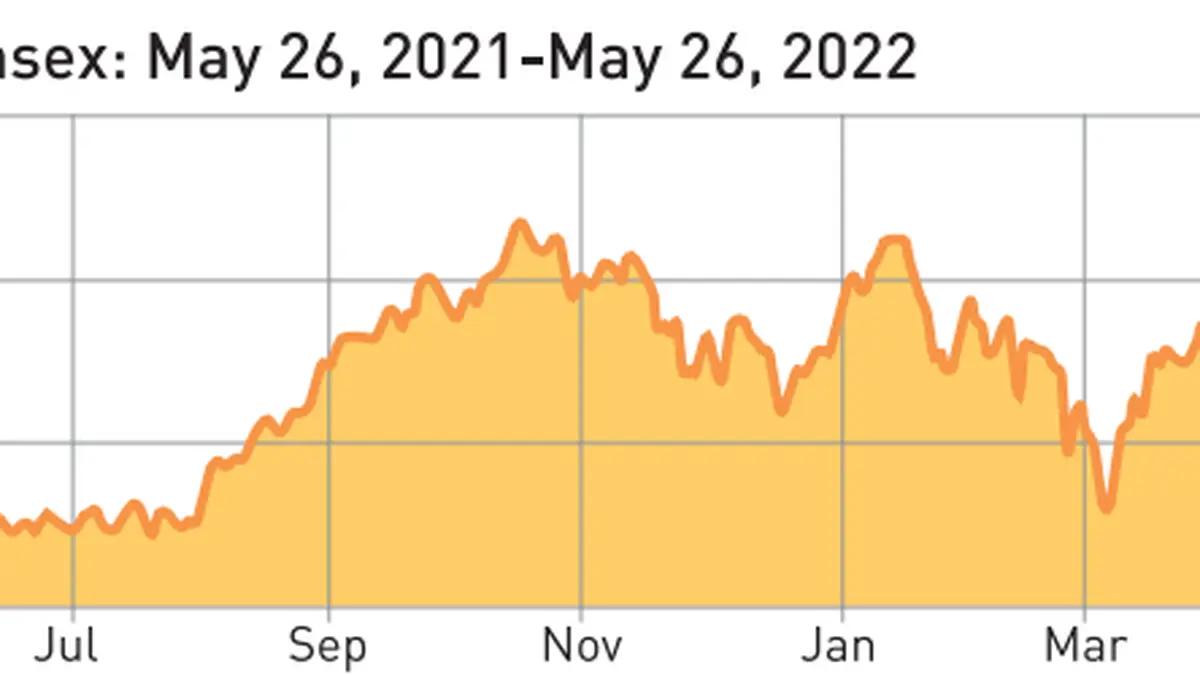

After a strong performance in equities throughout 2020 and most of 2021, the stock market began to decline in December 2021. This negative trend was triggered by foreign investors pulling out funds from Indian markets due to high inflation levels in the United States, which was compounded by the unexpected war in Ukraine. These events caused a 15% drop in the Indian stock market, leading to widespread concern among investors.
Analysts report that the market’s volatility index is at its highest level in a decade. “We anticipate another interest rate hike by the Reserve Bank of India (RBI), after which the indexes will stabilize. However, it will remain turbulent until later in the year,” said one analyst.
Examining the movements of the Bombay Stock Exchange (BSE) over the past year reveals the market’s fluctuations and its correlation with inflation. On June 1, 2021, the stock market closed at 51,934.88 Sensex points. It remained in this range for several months before starting to rise in September, reaching its peak at 61,765 points on October 18. November and December saw significant fluctuations. The market experienced a slight recovery in January 2022 but plummeted to 53,424.09 in February due to the Ukraine war. It rebounded to 59,276.69 in April but then dropped to 52,792.23 on May 19, losing 1,416.30 points. The National Stock Exchange (NSE) also experienced a decline of 430.90 points, closing at 15,809.40. This marked their worst day since February 24, 2022.
A comparison of the stock market’s movement with inflation rates from the RBI during the same period highlights the inverse relationship between the two. For example, inflation decreased from 6.26% in June 2021 to 4.48% in October 2021, during which the stock market was performing well. Conversely, as inflation rose to 6.01% in January 2022, the market became volatile, with the stock market index falling from 61,223.03 to 57,200.23. In April, inflation reached an eight-year high of 7.79%, coinciding with a drastic decline in the markets.
Analysts are concerned about the erosion of wealth, particularly the impact on retail investors. In the past decade, individual investors have increasingly turned to equity, leading to a significant increase in their participation in stock trading. According to the NSE’s quarterly report of January 2022, retail ownership rose steadily from 8.4% in January 2021 to 9.3% by the end of September. The number of retail investors, as reported by the NSE, was 20 million in 2012 and reached 50 million by December 2020.
Causes of the Market Decline
The market’s volatility has been attributed to disrupted supply chains worldwide due to the Ukraine war, which caused commodity prices for wheat and oil to rise. This resulted in inflation, leading to interest rate hikes by the US Federal Reserve and the RBI. The RBI’s surprise announcement of a 40 basis points interest rate increase in May further unsettled the markets.
However, analysts point out that the downturn began before the war. Data from the Central Depository Services Limited (CDSL) shows that Foreign Portfolio Investors (FPIs) and Foreign Institutional Investors (FIIs) started withdrawing in April 2021. In just five months, from January to May 2022, FPIs/FIIs withdrew Rs.1,62,299.61 crore, according to CSDL. FIIs/FPIs hold a 22% presence in Indian markets, second only to Indian promoters who hold about 32% of Indian stock, as per NSE data.
Inflation has a ripple effect on companies, which subsequently affects the stock market. Rising interest rates also have a negative impact on companies’ borrowing costs. For example, cement companies, a large market presence, are increasing product prices to manage commodity risk, creating concerns about borrowing costs. As a result, profits are expected to be under pressure in the coming year, affecting the stock prices of these companies, according to analysts.
Larsen and Toubro, a major infrastructure company, confirmed what analysts have been saying for months during its fourth quarterly results conference. The company’s management acknowledged that geopolitical uncertainties and volatile commodity prices, particularly crude oil, were driving up input costs. The depreciating rupee against the dollar will further intensify the pressure on commodity prices, leading to additional decline. “Only a few sectors have sustained this onslaught. The market has fallen below the danger level. A recovery might only be seen in the second half of the year,” said Miten Mehta from Bellwether Finance in Mumbai.
One of the sectors affected the most by the declining stock market is the new age technology sector. Companies like Zomato, Nykaa, and PolicyBazaar made recent listings on the Indian bourses with much excitement. (PayTM, on the other hand, immediately lost value upon listing.) However, following recent events, share prices of these companies have plummeted by anywhere from 50% to 80% of their peak values.